
Last updated July 10, 2026
Seasonal Air Duct Cleaning Care for Bridgeport: Year-Round Homeowner’s Guide
The worst time to discover your ducts are loaded with mold spores is the first cold morning you fire up the heat in October — by then, you’ve already spent a full summer incubating the problem. In Bridgeport, our coastal New England climate doesn’t just create four seasons; it creates four distinct duct stress events, each depositing different contaminants and demanding different responses. Most homeowners treat duct care as a once-a-year task, which means they’re always one season behind the problem. This guide breaks down what your duct system actually faces each quarter in Bridgeport, what you can handle yourself, and when the job requires professional-grade equipment that doesn’t fit in a home improvement van.
Quick Answer
Bridgeport homeowners should treat air duct maintenance as a quarterly practice, not an annual appointment. Fall heating startup, winter condensation cycles, spring pollen infiltration, and summer pressure shifts each create unique contamination risks that require season-specific inspection and cleaning protocols. A professional cleaning with Rotobrush and Nikro equipment every 2–3 years, combined with seasonal homeowner checks, keeps indoor air quality consistently safe year-round.
Table of Contents
- Fall: The Highest-Risk Air Quality Event of the Year
- Winter: How Cold Snaps Create Hidden Moisture Problems
- Spring: Pollen, Coastal Vegetation, and Return-Air Infiltration
- Summer: Pressure Dynamics and Debris Migration
- Month-by-Month Action Calendar for Bridgeport Homeowners
- What Professional Equipment Actually Does (And Why It Matters)
- Common Mistakes to Avoid
- When to Call a Professional
- Frequently Asked Questions
- The Bottom Line
Fall: The Highest-Risk Air Quality Event of the Year
September in Bridgeport still feels like summer, but your ductwork has been sitting idle since May. That idle period is the danger zone. Warm, humid air settles into every branch of your system through the summer, and without air circulation, condensation pools in low spots — especially in older Bridgeport homes with basement trunk lines running through unconditioned crawl spaces.
When you finally hit the thermostat in October, that first heating cycle does three things simultaneously:
- It aerosolizes everything that’s been growing undisturbed. Mold colonies, dust mite debris, and bacterial biofilms that established themselves over the summer get blasted into your living space in the first 48 hours of operation.
- It creates a pressure shock. Months of static pressure equalization end suddenly. Loose debris in vertical drops and horizontal trunk lines that stayed put all summer now migrates toward supply registers.
- It reveals mechanical problems under load. Heat exchangers stressed by summer humidity, blower motors with bearing corrosion from salt air — the first cold snap exposes weaknesses that were invisible in September.
In our 20 years working Bridgeport homes, we’ve found the Black Rock and Brooklawn neighborhoods particularly prone to fall startup issues because of their concentration of pre-1950s construction with original galvanized ductwork. Those systems have decades of accumulated debris and more seams where humid summer air infiltrates.
What to check in September before you touch the thermostat:
- Remove and inspect two supply registers — one on the first floor, one upstairs. Look for black or gray discoloration on the back side that wipes off with a finger. That’s active microbial growth, not ordinary dust.
- Run your hand along accessible basement trunk lines. Any dampness or white efflorescence on metal indicates condensation problems that will worsen when heated air hits cold metal.
- Listen to your blower cabinet on “fan only” mode before heating season. Grinding, squealing, or rhythmic thumping means bearing wear that will fail under winter load.
- Check your filter slot for gaps. Bridgeport’s fall leaf mold and urban particulate will find every unsealed entry point.
These checks are homeowner-appropriate. If you find active growth or moisture, that’s when professional intervention with Rotobrush mechanical cleaning and Abatement Technologies sanitizing becomes necessary — not after you’ve been breathing it for two months.
Winter: How Cold Snaps Create Hidden Moisture Problems
Bridgeport winters deliver the classic New England freeze-thaw cycle, but the real damage happens inside your walls where you can’t see it. When outdoor temperatures drop below 20°F for consecutive days — common in January and February — the temperature differential between your heated air and cold duct surfaces in exterior walls creates sustained condensation.
Here’s the mechanism we see repeatedly in Bridgeport fieldwork: warm supply air (120–140°F from a gas furnace) travels through duct runs embedded in exterior walls or unconditioned attic spaces. The inner duct surface cools to the dew point. Moisture forms. In a perfectly sealed system, this is minimal. But in real Bridgeport homes — especially the multi-family conversions common in the East End and South End — duct seams leak, insulation settles, and vapor barriers fail.
The moisture doesn’t just sit there. It feeds:
- Penicillium and Aspergillus growth on fiberglass liner inside flex duct, which releases spores with every heating cycle
- Metal fatigue and corrosion in galvanized steel ductwork, particularly at seams and hanger points
- Ice damming in attic runs that thaws and refreezes, eventually splitting duct seams open
We’ve pulled apart duct systems in February where the interior looked like a petri dish — not because the homeowner neglected maintenance, but because they didn’t understand that winter operation itself was the moisture source. The telltale sign: a musty smell that intensifies when the heat first cycles on after a cold night, then fades as the duct warms. That pattern means biological activity, not ordinary dust.
Winter-specific monitoring:
- Track your indoor humidity with a digital hygrometer. Bridgeport winter targets: 30–40%. Below 25% means your system is overdrying (and you’re more susceptible to static and respiratory irritation). Above 45% means moisture is accumulating somewhere it shouldn’t.
- After extreme cold snaps (below 10°F), check accessible registers for water staining or rust streaks. These indicate condensation events severe enough to reach your living space.
- Listen for whistling or roaring in specific rooms. Cold-weather duct contraction opens gaps that change airflow dynamics audibly.
Winter is not a cleaning season — it’s a detection season. What you observe in January determines what needs professional attention before spring pollen complicates the picture.
Spring: Pollen, Coastal Vegetation, and Return-Air Infiltration
Bridgeport’s spring allergy season hits differently than inland Connecticut. Our proximity to Long Island Sound means we get a double load: tree pollen from the urban canopy (oak, maple, birch concentrated in Seaside Park and Beardsley Park corridors) plus grass and weed pollen carried on maritime air currents from coastal vegetation zones. The result is a prolonged, intense pollen period from late March through early June.
Here’s what most homeowners miss: your return-air pathways are the entry vector, not your windows. Every time your system runs, it’s creating negative pressure at return registers that pulls air from wall cavities, basement spaces, and attic bypasses. If those pathways aren’t sealed, you’re importing outdoor pollen directly into your mechanical system — where it sticks to damp coil surfaces and duct walls, then recirculates for months.
The specific Bridgeport factor is our housing stock. Conversions of older homes — common in the West End and downtown — often have return-air pathways that were never properly engineered. Plumbers removed walls, electricians chased new routes, and the duct system adapted haphazardly. The result is return leaks that pull from musty basements, rodent-accessible crawl spaces, and exterior wall cavities loaded with decades of pollen accumulation.
Spring action items:
- Replace filters with MERV 11–13 pleated media (Honeywell or Aprilaire brands we specify) at the start of pollen season, not when they look dirty. By visual inspection, you’ve already lost efficiency.
- Inspect return-air register seals with a smoke pencil or incense stick. Air movement at the wall perimeter means duct leakage behind the drywall.
- Check your evaporator coil access if visible. Bridgeport’s spring humidity means coils stay wet longer, and pollen + moisture = biofilm that no filter stops.
Spring is the optimal season for professional cleaning if you missed fall preparation. The system has run all winter, debris is dry and mobile, and cleaning before AC season prevents the summer moisture problems we’ll cover next. In our experience, Bridgeport homeowners who schedule in April–May get the most thorough results because we can address both heating-season accumulation and seal return pathways before pollen peaks.
Summer: Pressure Dynamics and Debris Migration
Central air conditioning changes everything about how your duct system behaves. In heating mode, warm air rises naturally and supply registers on upper floors perform adequately even with modest pressure. In cooling mode, you’re forcing dense cold air upward against its natural tendency. That requires higher blower speeds, greater static pressure, and — critically — more aggressive debris migration from sections that stayed relatively stable all winter.
The Bridgeport summer pattern we observe: homeowners who cleaned ducts in fall or winter see debris reappear at upstairs registers by August. This isn’t failed cleaning; it’s physics. The higher pressure differential of AC operation dislodges material from trunk line dead zones and horizontal drops that heating-mode airflow never disturbed.
Compounding this is our coastal humidity. Bridgeport summer dew points regularly hit 65–70°F, meaning your cold supply ducts in warm attic or wall spaces are condensation magnets. Unlike winter condensation, which is intermittent and freeze-limited, summer condensation is sustained and warm — ideal for rapid biological growth. We’ve opened attic duct systems in August where the interior fiberglass liner was saturated and actively supporting mold colonies that released with every AC cycle.
Summer-specific risks:
- Debris migration from uncleaned sections. If your last cleaning was partial or superficial, summer pressure will expose the gaps. That “dust” around your upstairs registers in July is often debris that was always there, now mobilized.
- Condensation in supply runs. Cold air + humid envelope = water. Water + organic debris = growth. The cycle accelerates through July and August.
- Outdoor air infiltration through poorly sealed returns. Summer stack effect (warm air rising, creating negative pressure downstairs) reverses winter patterns and pulls humid outdoor air into basement and first-floor returns.
Summer is when we get the most emergency calls in Bridgeport — not because problems start then, but because the symptoms become unmistakable: musty smells when AC runs, visible debris at registers, or family members with allergy symptoms that disappear when they leave the house. By then, the underlying issue has been developing since fall.
Month-by-Month Action Calendar for Bridgeport Homeowners
This calendar separates homeowner-appropriate tasks from work that requires professional equipment. We’re explicit about this because we’ve seen too many Bridgeport homeowners damage flexible ductwork or create contamination problems with well-intentioned DIY attempts.
Homeowner Tasks (No Special Equipment)
| Month | Task | What You’re Looking For |
|---|---|---|
| March | Pre-season filter replacement; register inspection | Winter debris accumulation; register seal integrity |
| April | Return-air pathway smoke test; outdoor unit clearance | Leakage pulling from wall cavities; vegetation blocking intake |
| May | Coil access visual check (if accessible) | Biofilm or pollen buildup on evaporator fins |
| June | First AC cycle monitoring — odors, sounds, register debris | Musty startup smell indicating winter moisture damage |
| July | Mid-season filter check; humidity logging | Premature loading; indoor RH above 55% |
| August | Attic duct visual (if accessible) for condensation staining | Water marks, rust, or insulation displacement |
| September | Pre-heating inspection protocol (see Fall section) | Microbial growth; moisture; mechanical wear |
| October | First heating cycle monitoring — 48-hour window | Odor changes; airflow reduction; noise changes |
| November | Filter replacement; humidifier pad check (if equipped) | Proper humidifier function prevents winter dryness issues |
| December | Baseline humidity reading establishment | Target 30–40% for winter comfort and health |
| January | Post-cold-snap register inspection | Water staining; rust; airflow changes |
| February | System load assessment during sustained cold | Blower strain; uneven heating; unusual cycling |
Professional Service Windows
- March–May: Ideal for comprehensive cleaning if system ran all winter without service. Address heating accumulation before AC complicates with moisture.
- September–October: Critical window for pre-heating inspection and cleaning. Highest-value timing for Bridgeport’s climate.
- Emergency: Any month — musty odors, visible mold, water at registers, or post-renovation contamination.
Tasks requiring Rotobrush or Nikro equipment, duct camera inspection, or Abatement Technologies sanitizing are not homeowner-appropriate. We’ve repaired too many DIY-damaged flex ducts and addressed too many contamination spreads caused by improper agitation methods.
What Professional Equipment Actually Does (And Why It Matters)
The equipment gap between professional duct cleaning and consumer attempts is wider than most homeowners realize. We’ve invested in industrial-grade systems because Bridgeport’s duct challenges — coastal corrosion, older housing stock, multi-family conversions — require more than vacuum attachments.
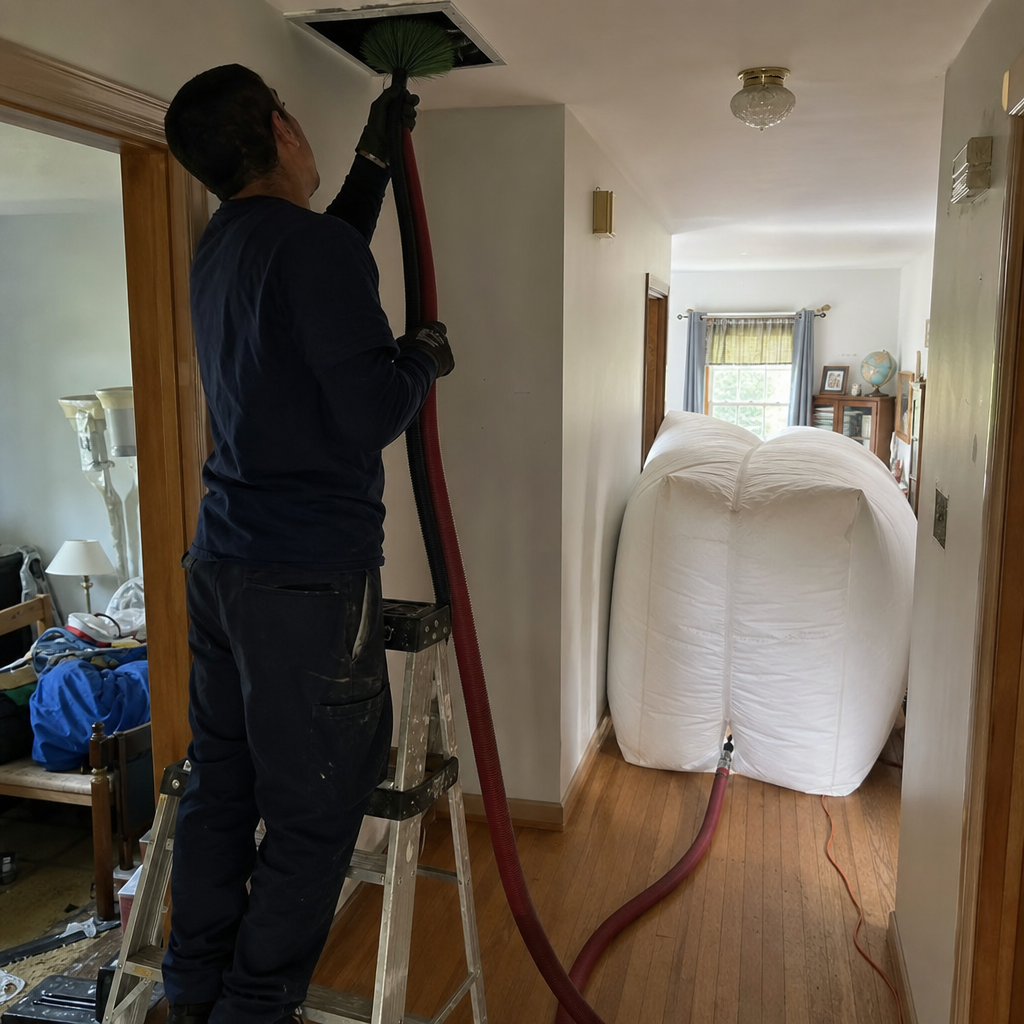
Rotobrush systems use rotating brush heads with simultaneous vacuum extraction. The brush physically dislodges debris adhered to duct walls; the vacuum captures it at the source before it can migrate. Consumer vacuums and brush kits lack the torque to agitate adhered material and lack the suction to prevent redistribution. We’ve retrieved construction debris from the 1940s from Bridgeport ducts — material that no passive vacuum would ever touch.
Nikro equipment provides negative air machines and HEPA filtration for containment. In occupied homes, especially Bridgeport’s tighter urban lots with limited ventilation, this matters. Without containment pressure, agitated debris escapes into living spaces during cleaning.
Abatement Technologies sanitizing products are EPA-registered for HVAC systems, not general disinfectants repurposed for ducts. The application requires controlled droplet size and dwell time that hand sprayers can’t achieve. We use these specifically for microbial contamination identified during inspection — not as routine “deodorizers,” which is a red flag for unprofessional practice.
Air quality testing with calibrated particle counters gives before-and-after verification that consumer methods can’t match. In our work, we document PM2.5, PM10, and specific mold spore counts so homeowners understand what changed — not just that it “smells better.”
The investment in this equipment reflects our positioning: Matthew handles your job personally — owner on-site, every time — and the tools match that commitment to doing the work correctly, not quickly.
Common Mistakes to Avoid
- Treating duct cleaning as a one-time event. Bridgeport’s four-season climate means your system faces distinct contamination cycles annually. A single cleaning addresses one snapshot, not ongoing dynamics.
- Using “vent cleaning” coupons without verifying equipment. We’ve inspected after cut-rate services that ran a shop vac hose 3 feet into the trunk line and called it complete. The remaining 80% of the system was untouched.
- Ignoring return-air pathways. Supply registers get attention because they’re visible. Returns are where outdoor contaminants enter, and they’re often the dirtiest components in Bridgeport’s older homes.
- DIY agitation with compressed air or drill attachments. These methods dislodge debris without capture capability. You may leave the duct looking cleaner while coating your home’s interior in decades of accumulated contamination.
- Scheduling cleaning after visible mold appears. By the time you see mold at registers, the problem is established throughout the system. Prevention through seasonal monitoring costs less than remediation.
- Neglecting dryer vent cleaning in seasonal planning. Lint accumulation peaks in winter when heavier fabrics run through dryers. A clogged vent strains your HVAC system’s air balance and creates fire risk. Our Dryer Vent Cleaning in Hartford page details the full protocol we apply across our Connecticut service area.
- Assuming new construction means clean ducts. Bridgeport’s renovation boom has produced homes with construction debris — drywall dust, insulation fragments, even fast-food wrappers — sealed inside ductwork by builders who never cleaned before close.
When to Call a Professional
Certain scenarios in Bridgeport homes exceed homeowner capability and require the equipment and expertise that only comes with professional service. Call for inspection when you observe:
- Visible mold or mildew at any register or in accessible ductwork
- Water staining, rust, or standing moisture in ducts or at registers
- Persistent musty odors that intensify with system operation
- Uneven airflow or temperature distribution that changes seasonally
- Post-renovation dust that doesn’t resolve with filter changes
- Family members with unexplained respiratory symptoms that improve away from home
- Any DIY cleaning attempt that released visible debris into living spaces
Elite Air Duct Cleaning Service Connecticut offers free estimates in Bridgeport — call (866) 531-5603. Matthew Gonzalez personally evaluates every job before quoting, so you’ll get an accurate scope based on your specific system, not a flat-rate guess. Two decades of duct systems means we’ve seen — and fixed — just about everything Bridgeport’s housing stock can present.
Frequently Asked Questions
Residential air duct cleaning in Bridgeport typically ranges from $400–$800 for a standard single-family home, depending on system size, accessibility, and contamination level. Multi-family conversions and homes with extensive duct repair needs fall outside this range. Call (866) 531-5603 for an exact quote — estimates are free and Matthew evaluates every system in person before pricing.
Every 2–3 years for maintenance cleaning, with annual inspection in September before heating startup. Homes with allergies, pets, or recent renovation may need more frequent service. Bridgeport’s coastal climate and older housing stock push toward the shorter interval — we’ve found 2-year cycles prevent the accumulation that leads to microbial problems.
Homeowners can and should perform seasonal monitoring: filter changes, register inspection, and basic leak detection. Actual duct cleaning requires equipment that agitates and captures simultaneously — consumer vacuums redistribute more debris than they remove. For mechanical cleaning, duct camera inspection, or sanitizing, professional service is the appropriate choice.
That odor is almost always microbial growth — mold or bacterial biofilm — that established during the idle summer months and activates when heated air hits it. In Bridgeport, basement and crawl space trunk lines are common locations. The smell fading after warmup means the growth is established but not yet severe; it’s a warning to schedule inspection before next season.
Yes. Salt air accelerates metal corrosion in exterior components and increases humidity load on the entire system. We’ve replaced ductwork in Black Rock and South End homes where salt corrosion compromised seams within 10 years — half the expected lifespan. The humidity also means biological contamination establishes faster and persists longer than in drier inland climates.
Our full service covers supply and return ductwork with Rotobrush mechanical agitation and HEPA vacuum capture, register and boot cleaning, blower cabinet and evaporator coil access cleaning, and post-service air quality verification. Duct repair, sealing, and Abatement Technologies sanitizing are available as needed. From cleaning to sealing to sanitizing — one call covers your entire duct system. For full service details, visit our Elite Air Duct Cleaning Service Connecticut home page.
The Bottom Line
Bridgeport’s coastal New England climate creates four distinct duct stress events annually, each with unique contamination risks. Treating duct care as a once-a-year task means you’re perpetually responding to problems instead of preventing them. The homeowners we see with the best outcomes — consistent air quality, minimal emergency calls, longest system lifespan — follow a simple pattern: September inspection before heating startup, spring filter and seal maintenance, professional mechanical cleaning every 2–3 years with Rotobrush and Nikro equipment, and immediate response to any moisture or odor signals rather than waiting for visible problems. 663 customers don’t leave 4.9 stars for average work, and two decades in Bridgeport’s unique housing stock means we’ve developed protocols that generic franchise playbooks don’t include.
Ready to schedule your seasonal inspection or cleaning? Call Elite Air Duct Cleaning Service Connecticut at (866) 531-5603 for a free estimate. Matthew handles your job personally — owner on-site, every time — and we’ll give you an honest assessment of what your system needs, what you can handle yourself, and what requires professional equipment. We use Rotobrush and Nikro equipment because your air quality isn’t a DIY project.
Written by Matthew Gonzalez, Owner & Lead Technician at Elite Air Duct Cleaning Service Connecticut, serving Bridgeport since 2006.