
Furnace Duct Cleaning Cost in Connecticut: What Oil, Gas, and Conversion Systems Actually Run
Our HVAC cleaning cost guide for Connecticut, CT breaks down why furnace duct cleaning typically runs between $350 and $850 for a complete residential system, with oil-heated homes landing at the higher end due to soot remediation requirements. Most jobs in Hartford, New Haven, and Fairfield counties take 3–5 hours and can be scheduled same-week. Call (866) 531-5603 for a free, itemized estimate — Matthew handles your job personally, owner on-site, every time.
Connecticut’s heating landscape isn’t like most of the country. We’re one of the last states where oil heat dominates — roughly 40% of homes still burn heating oil, compared to under 5% nationwide. That residue doesn’t stay in the furnace. It circulates. And if the crew you hire treats your oil-soot returns like a standard gas system, you’re paying for a surface-level vacuum job while the real contamination bakes back into your air every winter.
Why Oil Heat Changes Everything About Your Duct Cleaning Quote
We pulled a rotary brush out of a return trunk in East Hartford last February that looked like we’d dragged it through a chimney. Black, tacky, slightly oily — the kind of deposit that an air-wash wand would glaze over like a coat of paint. That’s the reality of oil combustion byproducts in ductwork: they don’t behave like household dust. They adhere. They carbonize. They re-aerosolize when the furnace kicks on.
Gas systems produce different residues — finer, drier, more particulate than sludge. The cleaning approach changes, and honestly, so should the price. Here’s what we’ve learned over two decades of working on Connecticut furnace systems:
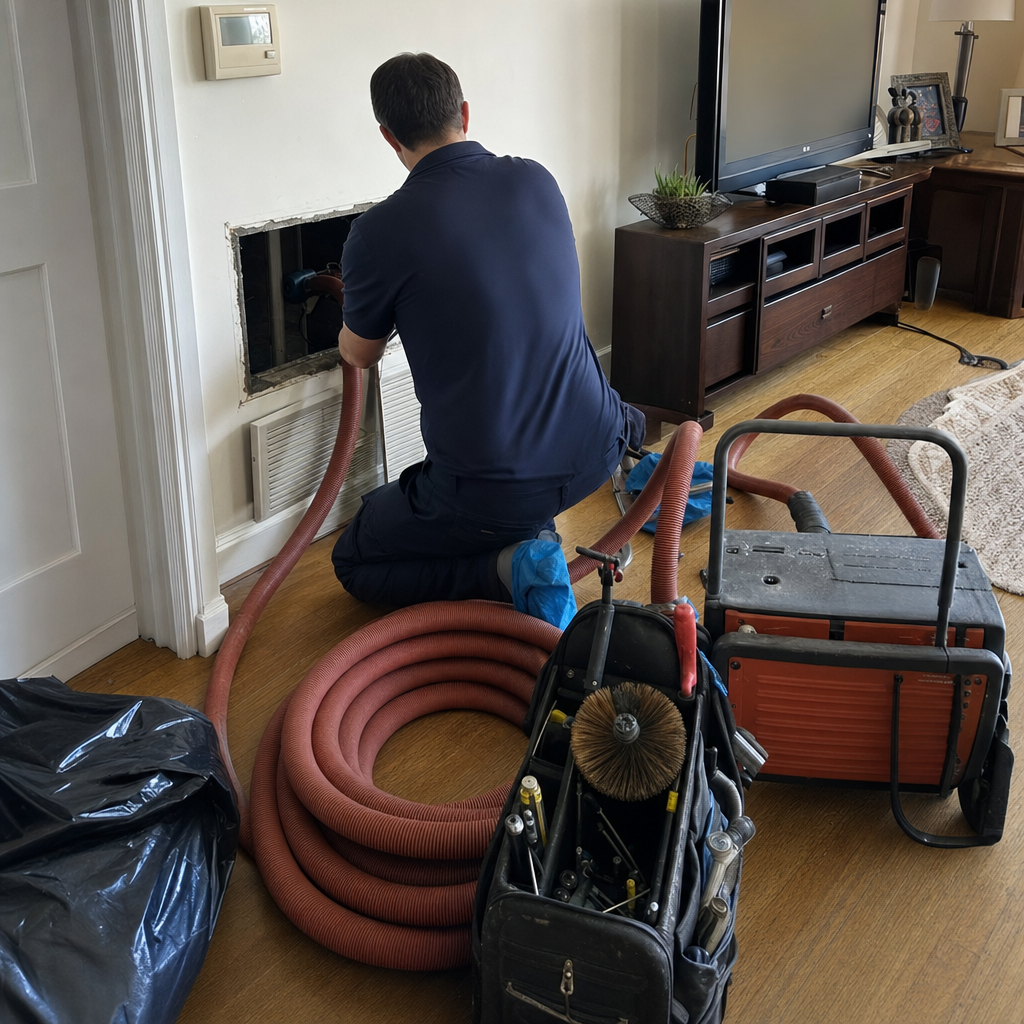
- Oil-heated homes need rotary mechanical agitation (we run Rotobrush systems with aggressive bristle configurations) plus high-CFM negative air extraction to dislodge and capture bonded soot
- Gas-heated homes can often be restored with thorough contact vacuuming and controlled air washing, though we still inspect for microbial growth in humid basements common across Connecticut’s shoreline towns
- Converted systems — oil-to-gas — carry the worst of both worlds: legacy oil deposits now being reheated by cleaner-burning gas, which actually increases the temperature differential and can accelerate re-circulation of old contamination
The conversion scenario is the one most contractors miss. You bought the new gas furnace. The conversion crew packed up. Nobody mentioned that the decades of oil residue in your returns is now getting hit with different combustion patterns, different airflow rates, and — in many cases — a smell that shows up in November and doesn’t leave till April. We’ve had calls from West Hartford and Hamden where homeowners thought their new furnace was defective. It wasn’t. The ducts were.
What Goes Into the Cost: Line-Item Breakdown
Matthew explains every line item before we start, because our HVAC duct cleaning service in Connecticut, CT is structured differently than what most companies call “furnace duct cleaning.” Some crews quote ductwork only and treat the furnace cabinet as an add-on. Others include the furnace but skip the coil, or clean returns but not supplies. Here’s how we structure it:
| Service Component | Typical Range (CT) | What Determines Where You Land |
|---|---|---|
| Full duct system cleaning (supplies + returns, 10–20 vents) | $350 – $650 | Home size, vent count, accessibility of trunk lines |
| Oil-heated system with soot remediation | $550 – $850 | Severity of residue, rotary agitation required, HEPA containment |
| Furnace cabinet & heat exchanger cleaning | $125 – $225 | Included in full-service packages; sometimes quoted separately by others |
| Evaporator coil cleaning (if accessible) | $150 – $300 | Location, contamination level, whether it requires partial disassembly |
| Post-cleaning air quality test | $75 – $150 | Particle count baseline vs. post-service; we use calibrated equipment |
| Sanitizing treatment (mold/odor concern) | $125 – $250 | Abatement Technologies or Guardsman application, duct size |
Two decades of duct systems means we’ve seen — and fixed — just about everything. The $350–$650 band covers most gas-heated Connecticut homes with standard fiberglass or metal ductwork. Oil systems with significant soot loading, or homes where we need to set up HEPA containment because of asthma or COPD concerns in the household, push toward the upper range. We use Nikro and Rotobrush equipment because your air quality isn’t a DIY project — and because a shop vac with a 20-foot hose doesn’t extract what we’re describing here.
The Oil-to-Gas Conversion Gap Nobody Talks About
Connecticut’s push toward natural gas conversions — Eversource and UI have run incentive programs for years — has left a specific ductwork problem in its wake. The new furnace goes in. The oil tank gets removed or capped. The utility rebates get processed. And the duct system? It still contains the accumulated particulate from 15, 30, sometimes 50 years of oil combustion.
Matthew grew up in New Haven’s Fair Haven neighborhood, where old triple-deckers and century-old heating systems were just part of the landscape — and where a drafty house in January meant business for anyone who understood ductwork. He picked up the fundamentals of HVAC and building systems through Paier College’s vocational programs and later honed his hands-on skills through coursework at Gateway Community College, which sits right in the heart of downtown New Haven. Over the past 20-plus years, he’s cleaned, inspected, and rebuilt duct systems in everything from 1920s colonials to modern commercial builds across Connecticut, and he’s become the guy local property managers call when nobody else can figure out why the air smells off.
That smell — it’s specific. Slightly acrid, more noticeable when the system first cycles on, sometimes described as “like a hair dryer burning dust” but heavier. It’s re-heated oil residue, and it’s not going away with a filter change. We’ve cleaned post-conversion systems in Bristol, Meriden, and Stratford where the homeowners had already replaced the furnace twice trying to solve it. The equipment wasn’t the problem.
If you’re planning a conversion, or you’ve completed one in the past two heating seasons, the duct cleaning should happen before the new gas system runs its first full winter. Not after. Not “when we get around to it.” The clean combustion of gas will heat those legacy deposits differently — higher stack temperatures in some configurations, different airflow dynamics — and you’ll be breathing the result till someone with a rotary brush and actual extraction power opens the system up.
How to Tell If Your Quote Is Actually Covering the Furnace
This is where customers get surprised. “Furnace duct cleaning” sounds comprehensive. It often isn’t. When you’re comparing quotes in Connecticut — whether you’re in a 1950s ranch in Wethersfield or a converted mill building in Willimantic — ask specifically:
- Does the price include the furnace cabinet, blower assembly, and heat exchanger visual inspection?
- Are supply ducts and return ducts both cleaned, or just the easily accessible supplies?
- For oil systems: is rotary mechanical agitation specified, or just “compressed air washing”?
- What’s the CFM rating on their extraction equipment? (Below 2,000 CFM won’t capture fine soot effectively)
- Is post-cleaning verification included — visual, particle count, or both?
We include furnace cabinet cleaning in our standard full-system service because — and this should be obvious, but apparently it isn’t — the air goes through the furnace. Cleaning ducts and ignoring the furnace is like brushing your teeth and skipping the gums. From cleaning to sealing to sanitizing — one call covers your entire duct system. We also offer HVAC Cleaning as a deeper mechanical service for systems with significant internal contamination.
663 customers don’t leave 4.9 stars for average work. They leave them when the technician shows up on time, explains what he’s finding in language that makes sense, and doesn’t invent problems that don’t exist. Matthew handles your job personally — owner on-site, every time. No rotating subcontractors, no commission-driven upsells, no “technician of the week” guessing at your system’s history.
Connecticut’s Climate Factor: Why Timing Matters
Our shoulder seasons are short. When the first cold snap hits in October — and it always hits harder than the forecast suggests — every duct cleaner in the state gets booked. The smart window is September through early October, or April after heating season ends — search HVAC cleaning near me in Connecticut, CT to lock in a slot before the rush. Oil systems especially benefit from post-season cleaning: the residue is dry, the furnace is cool, and we can be thorough without the pressure of “we need heat tonight.”
Humidity is the other Connecticut factor. Basements in shoreline towns — Bridgeport, New London, Groton — run damp through summer, and that moisture migrates into duct systems. Combine oil soot with humidity and you’ve got a substrate for microbial growth that a standard cleaning won’t address. We use Abatement Technologies HEPA containment and, where indicated, Guardsman sanitizing treatments specifically formulated for HVAC applications. Not bleach. Not “eco-friendly” marketing spray. Products rated for the environment they’re being applied in.
If you haven’t thought about what’s inside your ducts, your ducts have been thinking about it for you.
FAQs
Most Connecticut homeowners pay between $350 and $850 for complete furnace duct cleaning, depending on fuel type, system size, and contamination level. Oil-heated homes typically run $550–$850 due to soot remediation requirements, while gas-heated systems often fall in the $350–$650 range. Call (866) 531-5603 for an exact quote — estimates are free.
Cleaning is almost always the more cost-effective option unless your ducts are deteriorated, improperly sized, or contaminated beyond restoration — which we assess during our initial inspection. Replacement of even a partial duct system in Connecticut typically starts at $2,500–$4,000, making professional cleaning the practical first step. Call (866) 531-5603 and we’ll tell you honestly which category you’re in.
We typically schedule within 3–5 business days during peak season (October–March) and often within 1–2 days during shoulder seasons. Same-day service is sometimes available for urgent situations — post-conversion contamination, visible soot discharge, or respiratory concerns — but we won’t rush a job that requires proper containment and thorough extraction. Call (866) 531-5603 to check current availability.
Oil combustion produces heavier, more adhesive particulate that bonds to duct surfaces and requires rotary mechanical agitation plus high-CFM extraction to remove safely. Gas systems generate lighter, drier residue that’s more readily extracted with standard contact vacuuming. The equipment, time, and protective measures differ significantly — a crew quoting one price for both isn’t adjusting their method for either. Call (866) 531-5603 for an assessment of your specific system.
Ready to Know What You’re Actually Breathing?
Matthew Gonzalez, Owner & Lead Technician at Elite Air Duct Cleaning Service Connecticut, has spent 20 years opening up duct systems across this state — and he still finds things that surprise him. If you’re researching furnace duct cleaning cost because you suspect your system isn’t delivering the air quality your home needs, skip the coupon crews and get an owner-operated assessment with itemized pricing and no phantom add-ons. Call (866) 531-5603 for a free estimate, or visit our home page to learn more about our full range of indoor air services.
Written by Matthew Gonzalez, Owner & Lead Technician at Elite Air Duct Cleaning Service Connecticut, serving Connecticut, CT.