
How Often to Clean Air Ducts in Connecticut: The Real Interval Is Conditional, Not Calendar-Based
Most Connecticut homes need air duct cleaning every 2 to 4 years, but if you’re wondering Is Air Duct Cleaning Worth It? (Connecticut, CT), the honest answer depends on your heating fuel type, summer humidity exposure, filter quality, and whether you’ve renovated recently. Oil-heated homes in Connecticut’s older housing stock often need service closer to every 18–24 months, while well-maintained gas or heat-pump systems with high-grade filters can stretch toward 5 years. For a precise read on your system, call Elite Air Duct Cleaning Service Connecticut at (866) 531-5603 — we offer free, no-pressure assessments statewide.
Matthew Gonzalez, our owner and lead technician, grew up in New Haven’s Fair Haven neighborhood, where drafty triple-deckers and century-old heating systems were just part of winter life. After training through Paier College’s vocational programs and Gateway Community College, he spent two decades cleaning, inspecting, and rebuilding duct systems across Connecticut — from 1920s colonials in West Hartford to modern commercial builds in Stamford. He’s become the technician local property managers call when nobody else can figure out why the air smells off. If you haven’t thought about what’s inside your ducts, your ducts have been thinking about it for you.
Why Connecticut’s Climate Breaks the National “3–5 Year” Rule
The brochure recommendation of 3–5 years assumes a mythical average American home with moderate humidity, gas heat, and standard occupancy. Connecticut doesn’t fit that profile. Our state has roughly six months of continuous heating season, summer humidity that regularly pushes 65–75%, and more pre-1980 housing per capita than most of the country. These aren’t trivia points — they’re variables that directly change how fast your ductwork loads with debris, microbial growth, and combustion byproducts.
Here’s what Matthew sees in the field that national guidelines miss:
- Summer humidity and mold risk: When A/C runs continuously from June through September, condensate drains that aren’t maintained regularly create moisture pockets inside duct trunks — particularly in basements and crawl spaces. We’ve scoped systems in Groton and New Britain where visible mold colonization appeared within 14 months of the last cleaning because humidity control failed upstream.
- Oil heat combustion deposits: Connecticut still has significant oil-heat penetration, especially in older homes from Bridgeport to Waterbury. Oil combustion produces heavier particulate loads than natural gas, and return ducts in oil-heated homes pull soot, unburned fuel residue, and sulfur compounds through the system. Matthew’s field data — not a franchise playbook — suggests oil-heated homes benefit from inspection at 18-month intervals and cleaning by 24 months.
- Pollen season intensity: Connecticut’s tree pollen peaks in April and May, grass pollen in June, and ragweed from August through October. Homes with MERV-8 or lower filters, or filters changed irregularly, see return ducts loaded with organic material that becomes a nutrient base for microbial growth when summer humidity hits.
- Older housing stock = leaky ductwork: Pre-1980 homes often have unsealed duct joints, fiberglass liner degradation, or original metal ductwork with decades of accumulated layers. Leaky return ducts pull air from attics, crawl spaces, and wall cavities — introducing insulation particles, rodent debris, and construction dust that a sealed modern system wouldn’t see.
A Self-Assessment: What’s Your Actual Interval?
Matthew’s honest take after 20 years in Connecticut homes: he’s cleaned systems that looked acceptable at 4 years and found serious buildup at 18 months post-renovation. The calendar is a starting point, not a diagnostic. Use this framework to estimate where your home falls.
Factors That Shorten Your Cleaning Interval
| Condition | Recommended Interval | Why It Matters |
|---|---|---|
| Oil heat + pre-1980 home | 18–24 months | Combustion deposits + leaky returns accelerate loading |
| Recent renovation (last 2 years) | 12–18 months post-project | Construction dust bypasses filters, settles in duct trunks |
| 2+ pets with dander | 24–30 months | Pet hair wraps around blower wheels and loads return ducts |
| MERV-8 or lower filters | 24–30 months | Poorer particle capture lets fine debris accumulate downstream |
| Visible moisture/condensate issues | Inspect immediately | Humidity + organic debris = mold colonization risk |
| Occupants with asthma or allergies | 24–30 months, with air quality testing | Particle load directly affects symptom management |
Factors That Extend Your Cleaning Interval
- MERV-13 or higher filters changed on schedule: These capture 90%+ of particles 1–3 microns and larger, dramatically reducing what reaches your ductwork. In well-sealed homes, Matthew has seen gas-heat systems with MERV-13+ filters perform well at 4–5 year intervals.
- Heat pump systems (no combustion): Without oil or gas combustion byproducts, the primary loading source is environmental particulate — generally slower accumulation.
- Recently sealed ductwork: Professional duct sealing eliminates the “vacuum cleaner effect” of pulling attic and crawl space debris into returns.
- Whole-home dehumidification: Keeping relative humidity below 55% year-round suppresses microbial growth even if some organic debris is present.
What a Camera Inspection Reveals That a Calendar Can’t
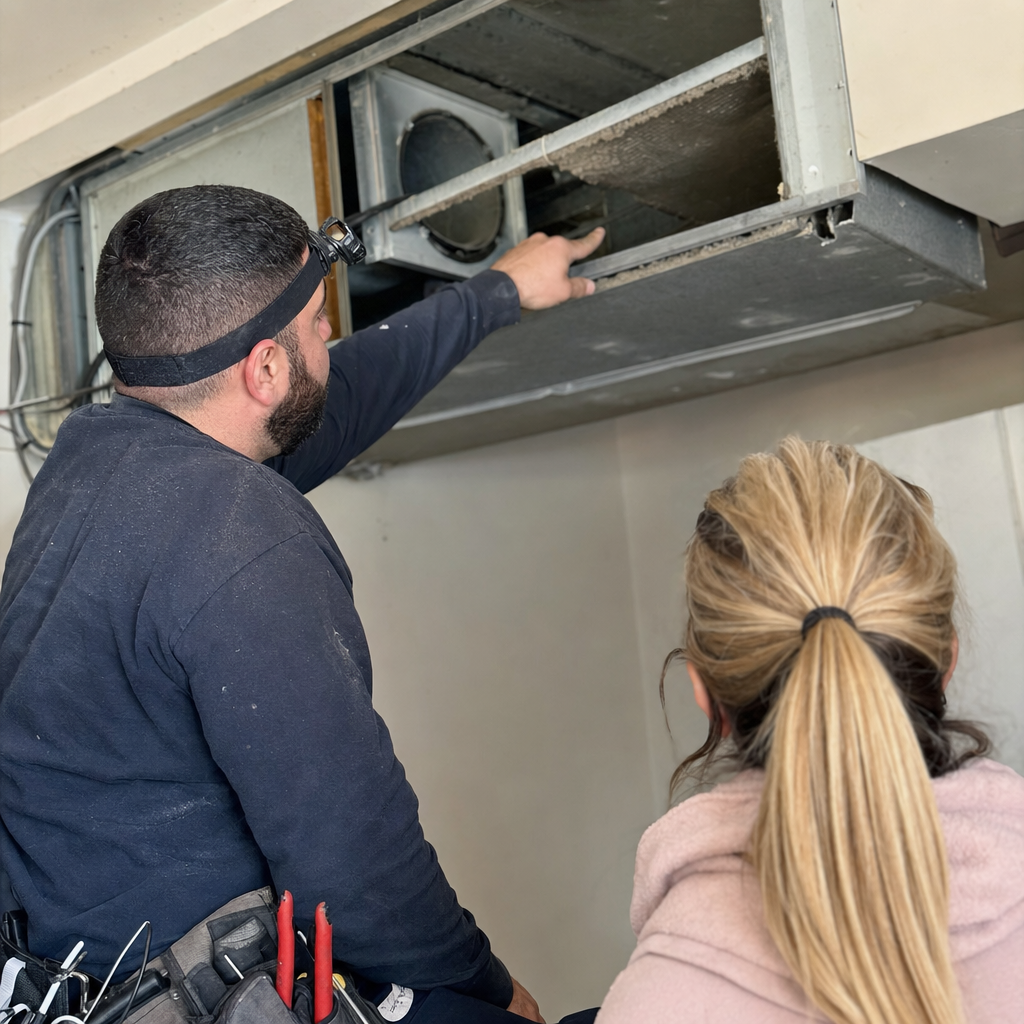
We use Rotobrush and Nikro inspection systems — the same commercial-grade equipment deployed in medical and industrial settings — because your air quality isn’t a DIY project. A borescope pushed through your main trunk line shows what no calendar estimate can predict:
Visual buildup patterns: Dust accumulation on duct floors, hair and fiber wrapping around dampers, or sticky black residue near furnace connections (common in oil systems). Matthew once scoped a 3-year-old system in Meriden where a contractor had left fiberglass insulation scraps inside a new return trunk — the homeowner had no symptoms yet, but the material was already breaking down into respirable fibers.
Moisture signatures: Water staining, rust on metal ductwork, or white crystalline deposits indicating past condensation events. These are precursors to mold and often trace back to a clogged condensate drain or missing insulation that a homeowner wouldn’t detect without access.
Post-renovation debris: Drywall dust, sawdust, and insulation particles from even “clean” remodeling jobs. This material is typically finer than household dust and penetrates deeper into the system, where standard vacuums won’t reach it.
From cleaning to sealing to sanitizing — one call covers your entire duct system. We also offer Air Duct Cleaning as a standalone service, or bundled with repair and air quality testing for homes where the inspection reveals broader issues.
Filter Quality: The Variable That Multiplies Everything Else
Connecticut’s extended pollen season makes filter choice particularly consequential. Here’s how filter grade changes your effective cleaning interval:
| Filter Type | Particle Capture | Typical Impact on Cleaning Interval |
|---|---|---|
| Fiberglass panel (MERV 1–4) | Large particles only | Shortens interval significantly — often 18–24 months |
| Pleated MERV 8 | 3–10 micron particles | Standard baseline — 2.5–3.5 years typical |
| Pleated MERV 11 | 1–3 micron particles | Extends interval 6–12 months in most homes |
| Pleated MERV 13+ | Sub-micron particles, bacteria, smoke | Maximum extension — 4–5 years possible with sealed ducts |
Critical caveat: higher MERV filters restrict airflow if your system wasn’t designed for them. Matthew checks static pressure during assessments to confirm your blower motor can handle the upgrade without strain. We’ve seen homeowners install MERV-13 filters in 1970s furnaces and create more problems than they solve.
When “How Often” Becomes “Right Now”: Warning Signs
Certain conditions override any interval estimate. Call for inspection if you notice:
- Visible dust puffing from registers when the system cycles on
- Persistent musty or oily odors, especially at system startup
- Uneven heating or cooling that doesn’t trace to thermostat or damper issues
- Recent water intrusion in basement or crawl space — even “minor” flooding
- Respiratory symptoms that worsen seasonally or when the system runs
- Evidence of pests (droppings, nesting material) near duct access points
Two decades of duct systems means we’ve seen — and fixed — just about everything. 663 customers don’t leave 4.9 stars for average work.
What Professional Cleaning Actually Includes (and Why Equipment Matters)
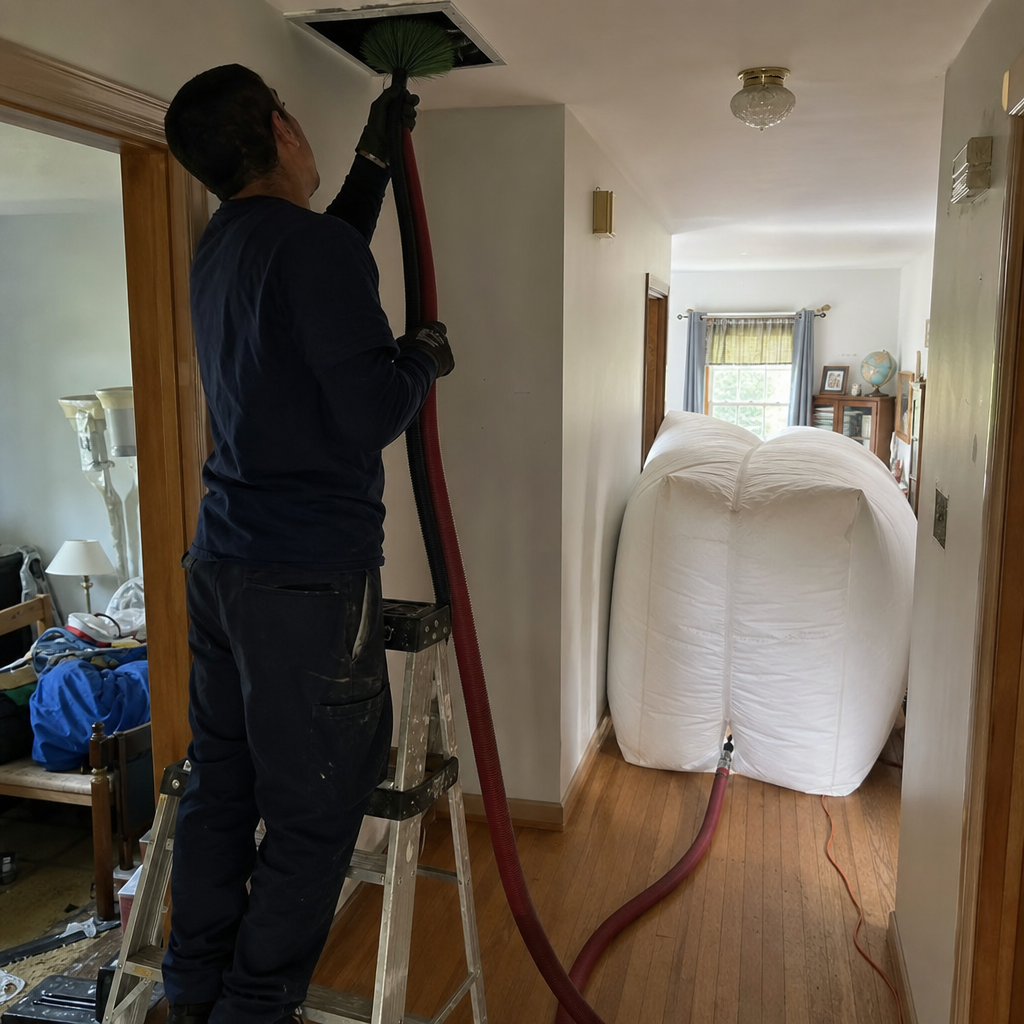
Not all “duct cleaning” is the same. National franchise crews often arrive with portable consumer-grade vacuums and rotary brushes that agitate debris without sufficient extraction power. Our process uses Rotobrush and Nikro negative-air systems — HEPA-filtered, high-CFM equipment that maintains containment pressure throughout the cleaning cycle.
For homes where inspection reveals microbial activity, we apply sanitizing treatments using Abatement Technologies and Guardsman products — EPA-registered solutions designed for HVAC applications, not generic disinfectants that can leave harmful residues or corrode coil fins. Matthew handles your job personally — owner on-site, every time — so the assessment, cleaning, and any follow-up recommendations come from the same technician who scoped your system.
Our Air Duct Cleaning in Connecticut page details the full service process for residential and light-commercial properties statewide.
FAQs
Whole House Air Duct Cleaning Cost in Connecticut, CT typically ranges from $400–$900 for a standard single-system home, depending on duct complexity, accessibility, and whether sanitizing or sealing is included. Larger homes with multiple zones, commercial properties, or systems requiring significant repair work fall outside this range. Call (866) 531-5603 for a free, exact quote based on your specific layout — estimates are free and come with no pressure to schedule.
If you’re looking for Affordable Air Duct Cleaning in Connecticut, CT, stretching intervals beyond what your conditions warrant usually costs more in the long run. Heavy buildup requires more labor, longer vacuum run times, and sometimes repeated passes — a neglected oil-heat system can take 2–3x longer to clean than one maintained on a reasonable schedule. More critically, accumulated debris strains your blower motor, reduces heat exchanger efficiency, and can trigger costly HVAC repairs that dwarf cleaning costs. Matthew’s seen $200 in deferred maintenance turn into $1,800 in blower and coil work.
Dirty ducts don’t automatically cause illness, but they can significantly worsen indoor air quality for sensitive individuals and contribute to respiratory irritation, allergy symptoms, and asthma triggers in susceptible occupants. The real concern isn’t “dirt” in the abstract — it’s the specific load of pollen, pet dander, mold spores, and combustion particulates that recirculate through your living space. For households with asthma or allergy concerns, we recommend pairing duct cleaning with air quality testing to identify whether your system is the source or just one contributor.
Request before-and-after photo documentation from the main trunk lines and at least two branch runs — any competent technician with inspection equipment should provide this. You should also see visibly cleaner registers, no residual debris around access points, and a post-service report noting any damage or conditions found. Matthew provides this documentation on every job, along with filter upgrade recommendations and any repair or sealing needs identified during cleaning. If your previous cleaner can’t show you what they removed, they probably didn’t remove much.
Your Next Step: Get an Honest Assessment
If you’d rather have it looked at than guess, Elite Air Duct Cleaning Service Connecticut offers a no-pressure assessment anywhere in Connecticut — call (866) 531-5603. Matthew will scope your system, explain what he finds in plain terms, and recommend a timeline that actually fits your home’s conditions rather than a national average.
Written by Matthew Gonzalez, Owner & Lead Technician at Elite Air Duct Cleaning Service Connecticut, serving Connecticut, CT.