
Signs You Need Dryer Vent Cleaning in Connecticut: The Visible Symptoms and the Hidden Risks Most Homeowners Miss
The clearest signs you need dryer vent cleaning are clothes that stay damp after a normal cycle, a dryer exterior that feels unusually hot, a burning smell during operation, and an exterior vent flap that doesn’t open when the dryer runs. In Connecticut’s older housing stock, you also need to check the physical vent path itself — crushed flex connectors behind the machine, lint-packed termination caps, and retrofitted vent runs that exceed safe length limits are warning signs that surface symptoms alone won’t reveal. If you’re noticing any of these, call Elite Air Duct Cleaning Service Connecticut at (866) 531-5603 for affordable dryer vent cleaning in Connecticut, CT — we’ll diagnose it properly and clean it thoroughly.
Connecticut’s housing landscape creates a perfect storm for dryer vent problems. We’ve got colonials from the 1920s, triple-deckers in New Haven’s Fair Haven neighborhood where Matthew grew up, post-war capes in the suburbs, and split-levels from the 1970s — many with dryer vents that have been modified, extended, or rerouted through finished basements and kitchen renovations. The climate doesn’t help either: cold winters mean longer heating seasons, and when your gas furnace or oil burner shares a mechanical room with a lint-choked dryer vent, you’ve got two of the three sides of a fire triangle sitting right next to each other.
What Most “Signs” Articles Get Wrong — And What We Actually Find on Connecticut Jobs
Every blog post on this topic repeats the same five symptoms. They’re not wrong, but they’re incomplete — especially for the homes we work on across Connecticut. Here’s the standard list, and then what we add after two decades of pulling lint out of systems that were genuinely dangerous.
The Surface Symptoms Everyone Lists
- Longer dry times: A load that used to take 45 minutes now needs 70 minutes or a second cycle
- Hot dryer exterior: The cabinet or control panel feels noticeably warm to the touch
- Burning smell: A sharp, acrid odor during operation — lint overheating somewhere in the line
- Exterior flap barely moves: The termination cap’s louvers stay closed or barely flutter
- Excess lint inside the door seal: More accumulation than usual around the drum opening
These are real. We’ve seen all of them. But here’s what separates a homeowner who catches a problem early from one who calls us after a near-miss: the physical inspection points that don’t show up in generic content.
The Hidden Inspection Points Matthew Checks First
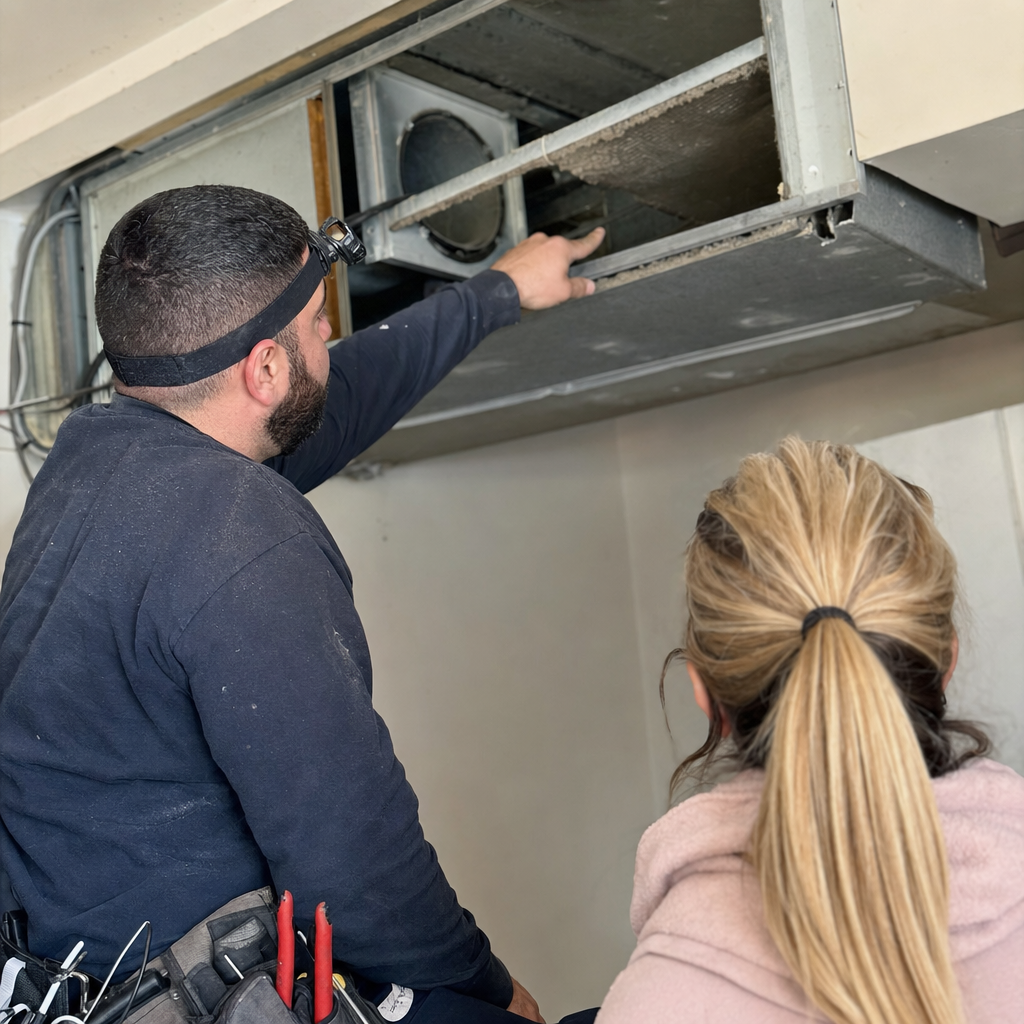
When Matthew Gonzalez arrives on a job — and he’s the one who shows up, owner and lead technician, not a subcontractor — he starts with the machine itself, not the symptoms the customer reported.
The flex connector behind the dryer. That ribbed aluminum or plastic transition hose between your dryer and the wall connection? It’s the most abused component in the entire system. We’ve found them crushed against the wall from pushing the dryer back too far, kinked like a garden hose, or partially detached and leaking lint into the mechanical room. In a 1960s ranch in Hamden last month, the flex connector had a split running six inches — the homeowner had been breathing lint particulate into the basement for months without knowing. If you can pull your dryer out safely (unplug it first, and if it’s gas, don’t disturb the connection), look for: flattening, tears, sagging that creates a lint trap, or a connector that’s been in place so long the ribs are packed solid.
The exterior termination cap. Walk outside and look at where your vent exits the building. The flap or louver should move freely when the dryer runs. But also check: is there lint packed around the hinge? Is the screen — if someone installed one — clogged with a felt-like mat? Are the louvers stuck partially open by paint, corrosion, or physical damage? In Connecticut’s coastal towns especially, we’ve seen salt air corrode metal caps until they seize. A stuck-open cap lets in cold air, rain, and pests. A stuck-closed cap traps heat and moisture inside.
The actual vent run length and routing. This is where Connecticut’s renovation history becomes critical. The International Residential Code limits dryer vent runs to 25 feet of equivalent length, with each 90-degree elbow adding 5 feet to that calculation. Two elbows and you’re at 35 equivalent feet maximum. We’ve measured vent runs in finished Connecticut basements that exceeded 50 feet because the laundry was moved and the vent was extended through soffits and bulkheads rather than routed properly. Longer runs mean slower airflow, which means lint deposits faster, which means clogs develop in months instead of years.
Bird and pest nesting. Connecticut’s suburban and wooded areas — think the Litchfield Hills, the Quiet Corner, shoreline towns with mature trees — attract birds that see a warm vent cap as prime real estate. Matthew describes the pattern: “You’ll get random drying failure. One load works fine, the next is damp, there’s no consistent pattern. That’s often a partial blockage — a nest that’s been built but hasn’t completely sealed the vent. The drum heats, but airflow is intermittent. From outside, the cap might look normal until you get close and see nesting material or droppings.” We’ve pulled out complete chickadee nests, paper wasp colonies, and once, in a Bristol home, a red squirrel’s winter cache that included acorns and dryer lint woven together.
How Connecticut’s Climate and Construction Create Unique Risks
The generic advice doesn’t account for what happens in a New England winter. Here’s what we’ve learned from 20 years of working in Connecticut homes.
The Heating Season Fire Risk Nobody Discusses
Lint buildup that’s borderline manageable in July becomes genuinely hazardous in January. Here’s why: your dryer vent is already running hot. Add a gas furnace cycling on and off in the same mechanical room, or an oil burner with its own combustion risks, and you’ve concentrated heat sources in a space where lint is the ideal fuel. The ignition temperature of dryer lint is approximately 135°F — well below the surface temperature of a restricted dryer cabinet during operation. We don’t see many dryer vent fires in August. We see them in February, when systems are stressed and mechanical rooms are running at maximum capacity.
If your mechanical room contains both your dryer and your heating equipment, and you can’t remember the last vent cleaning, that’s not a coincidence to ignore. That’s a specific risk profile that deserves immediate attention.
The “No Documentation” Rule
Matthew’s field rule for every property we assess: if there’s no service history, we treat the vent as overdue. This matters enormously in Connecticut’s real estate market, where homes change hands frequently and disclosure documents rarely include dryer vent maintenance. If you moved into your home and have no record of cleaning — or if you’re a property manager with turnover tenants who never think to ask — the safe assumption is that the system hasn’t been properly cleaned since installation. For a family doing five loads weekly, that’s potentially years of accumulation.
Renovation Retrofits That Exceed Safe Design
Connecticut’s housing stock is old and has been repeatedly modified. We’ve seen:
- Kitchen relocations to former dining rooms where the dryer vent now runs 30 feet through a soffit
- Finished basements where the original straight-through wall vent was rerouted through a dropped ceiling with three elbows
- Second-floor laundry installations in vintage homes where the vent terminates through the roof — a configuration that requires professional cleaning equipment to reach and maintain
Each of these modifications can push a system past its designed capacity. The dryer works harder, the lint accumulates faster, and the fire risk compounds.
What Professional Dryer Vent Cleaning Actually Involves — And What It Costs
Understanding what proper cleaning looks like helps you evaluate whether a service is worth the investment. At Elite Air Duct Cleaning Service Connecticut, our Dryer Vent Cleaning process follows a specific protocol developed over two decades.
Our Cleaning Process
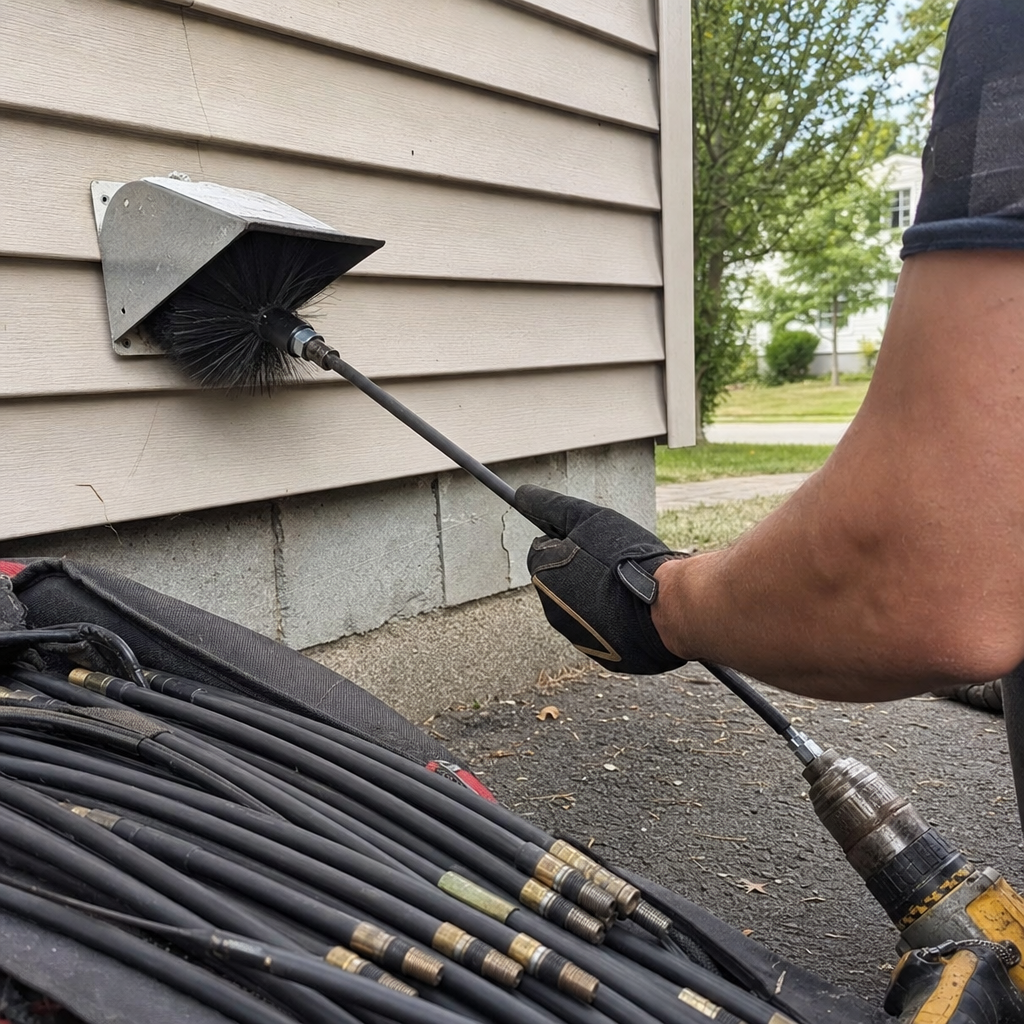
For the best dryer vent cleaning in Connecticut, CT, Matthew handles your job personally — owner on-site, every time. We start with airflow measurement to establish baseline restriction, then use professional-grade equipment from Rotobrush and Nikro — the same commercial-tier systems used in industrial and medical settings, not consumer vacuums with inadequate suction. For the main vent run, we use high-velocity air tools and mechanical brushes sized to your duct diameter. The flex connector gets replaced if damaged — we carry standard sizes on every truck. The exterior cap is removed, cleaned, and tested for proper operation. We finish with post-cleaning airflow measurement so you have before-and-after documentation.
For properties requiring sanitizing treatment — particularly where moisture has created microbial growth in the vent — we apply products from Abatement Technologies and Guardsman that are rated for HVAC systems and safe for residential use.
Pricing for Connecticut Properties
| Service | Typical Range | What Affects Cost |
|---|---|---|
| Standard dryer vent cleaning (single-family, accessible vent) | $150 – $275 | Length of run, number of elbows, accessibility of termination |
| Vent with bird nest or pest removal | $200 – $350 | Extent of nesting, need for cap repair/replacement |
| Long-run or rooftop termination | $250 – $400 | Equipment needed to reach, safety requirements for height work |
| Flex connector replacement | $35 – $75 | Length and material (aluminum vs. semi-rigid) |
| Air quality testing package (add-on) | $125 – $195 | Number of sampling points, particulate vs. full VOC panel |
We don’t quote over the phone for complex configurations — we need to see the routing. Estimates are free, and we’ll show you exactly what we find before any work begins.
Key Takeaways: When to Call for Dryer Vent Cleaning
- Visible symptoms: Long dry times, hot exterior, burning smell, weak exterior airflow
- Physical checks: Crushed flex connector, damaged or stuck exterior cap, lint-packed termination
- Connecticut-specific triggers: Renovation-extended vent runs, heating season proximity to furnace/boiler, no service documentation
- Pest indicators: Inconsistent drying performance with no other explanation — check exterior cap for nesting material
- The memory test: If you can’t recall the last cleaning, or you’re new to the home with no records, schedule inspection
FAQs
If you’re wondering how much dryer vent cleaning costs in Connecticut, CT, standard service typically runs $150 to $275 for accessible single-family installations, with complex or long-run systems reaching $250 to $400. The main cost drivers are vent length, number of elbows, termination accessibility, and whether pest removal or connector replacement is needed. Call (866) 531-5603 for a free, no-pressure estimate — we’ll assess your specific configuration and quote before any work starts.
DIY brush kits cost $20 to $40 but rarely clean the full vent run effectively, especially in Connecticut homes with long or elbow-heavy retrofits, and they can’t address pest blockages or measure airflow improvement. Professional cleaning with commercial Rotobrush and Nikro equipment, proper airflow testing, and the ability to replace damaged components typically pays for itself in energy savings and fire risk reduction within a single heating season. If you haven’t thought about what’s inside your ducts, your ducts have been thinking about it for you — call (866) 531-5603 for an assessment.
For typical Connecticut households doing 4 to 6 loads weekly, we recommend annual inspection and cleaning every 12 to 18 months; heavy-use families, homes with pets (pet hair accelerates buildup), or properties with long vent runs should schedule every 6 to 12 months. The heating season adds urgency — lint accumulation near combustion equipment is riskier November through March. If you have no service history for your home, treat it as overdue regardless of apparent symptoms. Call (866) 531-5603 to establish a maintenance schedule.
We prioritize same-day and next-day response for active warning signs — burning smells, extremely hot cabinets, or complete airflow blockage — because these indicate imminent fire risk. For standard scheduling, we typically book within 48 to 72 hours across our Connecticut service area. Emergency calls get Matthew directly; he’s the one who answers and the one who arrives. If you’re experiencing active symptoms, don’t wait — call (866) 531-5603 now and we’ll fit you in.
From Two Decades in Connecticut Homes: The Call We Don’t Want You to Have to Make
We’ve responded to properties where the homeowner smelled smoke before the alarm triggered. We’ve opened vents packed so solid with lint that the brush barely turned. We’ve replaced flex connectors that had literally disintegrated from heat exposure. Every one of those calls started with symptoms that were ignored or dismissed.
The good news: dryer vent problems are predictable, inspectable, and fixable before they become dangerous. The surface symptoms are easy to spot. The hidden inspection points — the crushed connector, the overlong retrofit, the heating-season proximity risk — are what separate a quick cleaning from a disaster prevented.
Matthew Gonzalez has cleaned, inspected, and rebuilt duct systems across Connecticut for over 20 years, from 1920s colonials to modern commercial builds. He started this business because his youngest daughter has asthma, and he wanted to do work that made a measurable difference in the air people breathe — not just entries on an invoice. That foundation still drives how Elite Air Duct Cleaning Service Connecticut operates: owner on every job, commercial-grade equipment, and the kind of specific expertise that comes from having seen virtually every duct configuration New England housing can produce.
663 customers don’t leave 4.9 stars for average work. From cleaning to sealing to sanitizing — one call covers your entire duct system.
If you’d rather have it looked at than wonder, Elite Air Duct Cleaning Service Connecticut offers a no-pressure assessment anywhere in Connecticut — call (866) 531-5603 for a free estimate.
Written by Matthew Gonzalez, Owner & Lead Technician at Elite Air Duct Cleaning Service Connecticut, serving Connecticut, CT.