
Last updated July 10, 2026
Air Duct Cleaning Maintenance Checklist for Bridgeport Homeowners
Here’s the uncomfortable truth we see in Bridgeport homes every week: a spotless return-air filter tells you almost nothing about what’s happening 30 feet deeper in your duct system. We’ve opened up supply lines in Black Rock condos and Brooklawn colonials where the filter looked brand-new — yet the trunk line was lined with construction debris from a 2019 renovation, or thick with pollen deposits baked in by decades of Connecticut humidity cycles. After 20 years inspecting ductwork across Fairfield County, Matthew Gonzalez has developed a six-point physical inspection routine that catches problems before they trigger allergy flare-ups, HVAC strain, or four-figure cleaning bills. This guide gives you that same checklist, plus the logging system that protects your home’s value and your family’s air.
Quick Answer
Bridgeport homeowners should inspect their duct system every 90 days during heating season and every 60 days during peak allergy season (April–June), focusing on six physical checkpoints: return grille debris, supply register dust patterns, visible trunk line deposits, duct boot connections, blower compartment contamination, and airflow consistency across rooms. Filter changes alone won’t prevent buildup — documented visual inspections catch what filters miss.
Table of Contents
- Why Filters Fail to Tell the Whole Story
- The Six Physical Checkpoints Matthew Inspects on Every Job
- Bridgeport-Specific Maintenance Intervals
- How to Log and Date Your Inspections
- DIY Maintenance vs. Jobs That Require Professional Equipment
- Decision Tree: Call Now or Wait Another Season?
- Common Mistakes to Avoid
- When to Call a Professional
- Frequently Asked Questions
- The Bottom Line
Why Filters Fail to Tell the Whole Story
Most Bridgeport homeowners we meet are diligent about filter changes. They’ve got the Honeywell or Aprilaire pleated filters on subscription, they mark the calendar, they feel responsible. And they should — a clogged filter restricts airflow, strains the blower motor, and spikes energy bills. But here’s what two decades of ductwork inspection has taught us: filters are designed to protect the equipment, not the ductwork itself.
Standard 1-inch pleated filters capture particles down to roughly 3–10 microns. Fine pollen, skin flakes, cooking aerosols, and the particulate matter that drifts in from I-95 and the Metro-North corridor — much of this slips through. Once inside the system, it adheres to duct walls, especially where humidity swings cause condensation. Bridgeport’s coastal climate makes this worse: summer dew points in the 60s and 70s create the sticky film that traps particles, while winter heating dries and bakes deposits into hard layers.
We’ve pulled filters from homes in the North End that looked pristine, then camera-inspected the trunk line to find a half-inch mat of compacted debris. The filter did its job protecting the coil — but the ducts became a reservoir of contaminants recirculating with every system cycle. That’s why our checklist starts where the filter ends: at the grille, inside the boot, and down the line.
The Six Physical Checkpoints Matthew Inspects on Every Job
These are the same six points Matthew checks during his pre-job walkthrough. You can replicate most of them with a flashlight, a smartphone camera, and a screwdriver. We recommend doing this inspection twice yearly: once before heating season (October) and once before peak allergy season (April).
Checkpoint 1: Return Grille Debris Pattern
Remove the return grille — usually a simple snap-off or two screws. Look at the back side and the duct opening behind it. What you’re looking for:
- Uniform light dust: Normal. Wipe with damp microfiber.
- Clumped or stringy buildup: Indicates high humidity + particulate adhesion. Common in Bridgeport’s shoreline properties where salt air accelerates corrosion and debris binding.
- Dark, greasy film: Often cooking aerosols or candle soot. Sticky deposits attract more debris.
- Insect or rodent evidence: Droppings, nesting material, or chewed edges. Document with photos immediately.
Take a photo before cleaning. Date it. This single image becomes baseline evidence if conditions worsen.
Checkpoint 2: Supply Register Dust Patterns
Remove a supply register in each major zone (bedroom, living area, basement). Look at the dust pattern on the back of the register and the first 6 inches of duct beyond.
What the pattern tells you:
- Even, light coating: Normal accumulation.
- Thick ring around the edges: Indicates turbulent airflow dropping particles at velocity changes — often from undersized ducts or a struggling blower.
- Black streaks: Possible mold or mildew. Bridgeport’s older housing stock, especially pre-war homes in the East End and South End, often has uninsulated duct runs in exterior walls where condensation breeds microbial growth.
- Construction debris (drywall chunks, wood splinters): Leftover from renovation. We’ve found 15-year-old drywall dust in Stratford Avenue properties where the original contractor never protected the ducts during remodeling.
Checkpoint 3: Visible Trunk Line Deposits
If your basement or crawl space exposes any trunk ductwork, shine your flashlight down the longest straight run you can access. Look for:
- Visible debris thickness (compare to your photo baseline)
- Discoloration or staining
- Areas where the duct sags or has been crushed — these create low-velocity zones where debris collects
- Disconnected seams or gaps at joints
In Bridgeport’s flood-prone zones near the Pequonnock River and Black Rock Harbor, we’ve seen duct systems that sustained previous water intrusion. Rust staining on galvanized ductwork, or white powdery oxidation, signals past moisture events that may have compromised interior coatings.
Checkpoint 4: Duct Boot Connections
The boot is the angled transition piece between trunk line and register. It’s often the leakiest point in the system. With the register removed, reach in and feel around the boot-to-trunk connection. You’re checking for:
- Visible gaps where mastic or tape has failed
- Airflow you can feel escaping at the joint (run the system during this check)
- Dust streaks on the ceiling or wall around the register — telltale sign of pressurized leakage
Leakage here doesn’t just waste energy. It pressurizes wall cavities and ceiling spaces, pulling in insulation fibers, rodent droppings, and attic dust. In multi-family conversions common in Bridgeport’s West End and Hollow neighborhoods, we’ve found boot connections that were never properly sealed during the original 1980s subdivision.
Checkpoint 5: Blower Compartment Contamination
This requires accessing the air handler or furnace cabinet — typically a removable panel with a few screws. Safety note: Turn off power at the breaker before removing any panel. If you’re uncomfortable with this step, skip it and note it for a professional.
With power off and panel removed, inspect:
- The blower wheel blades — should be clean metal, not fuzzy with dust
- The evaporator coil (if visible) — should show fin definition, not matting
- The drain pan — should be clean, not sludged or algae-stained
- The interior cabinet walls — dust is normal, thick buildup is not
A contaminated blower wheel is the single best predictor of dirty ducts. It’s the heart of the system — if it’s dirty, the entire distribution network has been processing contaminated air. We’ve found blower wheels in Bridgeport’s 1960s ranch homes so loaded with debris that they were running 30% below rated airflow, causing rooms to stay cold despite the furnace cycling constantly.
Checkpoint 6: Airflow Consistency Across Rooms
No tools needed — just your hand or a strip of toilet paper. With the system running, check airflow at every supply register.
What to record:
- Which registers feel weak or strong
- Whether airflow changes when doors are open vs. closed
- If any room is consistently 3+ degrees different from the thermostat reading
In Bridgeport’s older homes with original duct sizing, we regularly see second-floor bedrooms in Cape Cods and split-levels starved for airflow because the original 1950s design prioritized first-floor heating. Duct balancing or modification — not just cleaning — may be needed.
Bridgeport-Specific Maintenance Intervals
Generic “change your filter every 3 months” advice ignores how Bridgeport’s climate and housing stock actually perform. Here’s what 20 years of local fieldwork has calibrated for us:
| Timing | Trigger | Action |
|---|---|---|
| Mid-October | Heating season startup | Full six-point inspection; replace filter; check blower compartment; document baseline photos |
| Early April | Allergy season onset | Inspect supply registers for pollen loading; check return grille for increased debris; consider professional cleaning if symptoms persist |
| Late June | Peak humidity | Check for condensation in basement/crawl trunk lines; inspect for mold indicators; verify dehumidifier operation if equipped |
| Post-renovation | Any remodeling, flooring, or painting | Immediate inspection within 48 hours of project completion; construction dust bypasses most filters |
| Post-flood or leak | Any water intrusion event | Professional inspection mandatory — mold colonizes duct insulation within 24–72 hours in Bridgeport’s climate |
| Pre-listing | Selling the home | Full documentation package; professional cleaning if last service >3 years; air quality test for buyer confidence |
The April–June window is particularly critical in Bridgeport. Tree pollen peaks in late April, grass pollen in May and June, and the city’s coastal position means maritime air masses keep humidity elevated. We’ve treated homes in the Seaside Park area where residents were running HEPA room purifiers 24/7 yet getting no relief — because the duct system was recirculating a pollen reservoir built up over years.
How to Log and Date Your Inspections
Documentation isn’t obsessive — it’s protective. A dated inspection log helps you:
- Track degradation rates and predict when professional cleaning is due
- Satisfy buyer requests during home sale (increasingly common in Bridgeport’s competitive market)
- Support insurance claims if contamination causes HVAC failure or health issues
- Verify warranty compliance for some equipment manufacturers
Simple logging format:
- Date and weather conditions — temperature and humidity affect what you’ll find
- Photos of each checkpoint — use your phone’s timestamp feature
- Numerical ratings — we suggest 1–5 scale for each checkpoint (1 = clean, 5 = professional service needed)
- Any changes from last inspection — new construction nearby, renovation work, weather events, health symptoms
- Filter change date and brand/spec — note if you upgraded or downgraded filtration
Store this in a dedicated folder — physical or cloud. If you ever sell, a three-year inspection history with photos signals responsible maintenance to buyers and their inspectors. We’ve been called to provide documentation letters for Bridgeport home sales where the buyer’s lender required proof of HVAC maintenance.
DIY Maintenance vs. Jobs That Require Professional Equipment
We’re straightforward about this because Matthew handles every job personally — owner on-site, every time. There’s no incentive to sell you service you don’t need. Here’s the honest division:
DIY-Appropriate Tasks
- Filter changes (match MERV rating to system capacity — too high restricts airflow)
- Grille and register wipe-downs with damp microfiber
- Return grille vacuuming with brush attachment
- Visual inspections per the six checkpoints
- Register and boot reattachment if loose
- Basic blower compartment visual check (power off)
Tasks Requiring Professional Equipment — No Exceptions
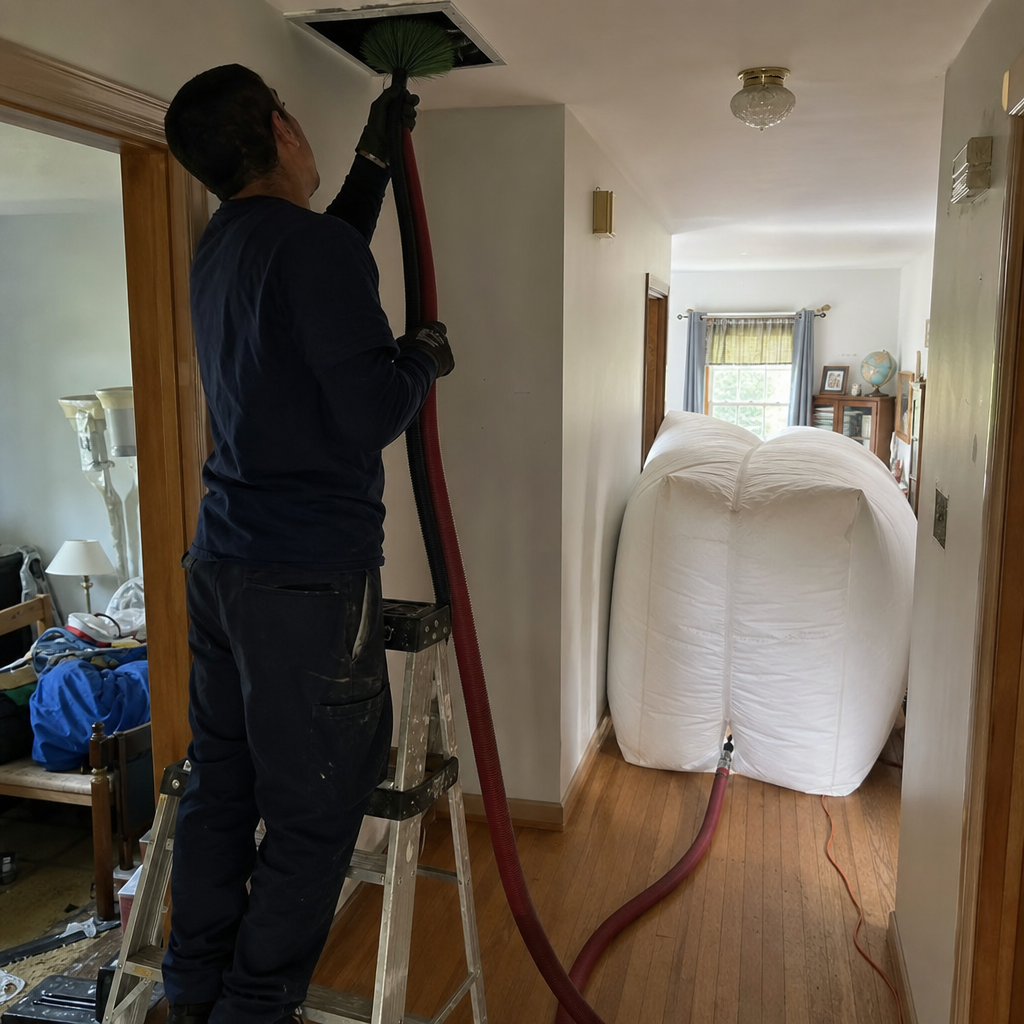
Mechanical duct cleaning: Rotobrush and Nikro systems use powered brushes and negative-air machines that agitate and extract debris from the full duct run. A household vacuum — even a shop vac — lacks the sealed extraction and brush reach. We’ve seen homeowners in Bridgeport’s North End punch holes in flex duct trying to snake a vacuum hose through 30-foot runs.
Coil and blower wheel cleaning: These components require chemical foaming agents and pressurized rinse systems that don’t damage fins or electronics. Improper cleaning bends coil fins permanently, reducing efficiency.
Air quality testing and sanitizing: We use Abatement Technologies and Guardsman products for verified microbial remediation. DIY “fogging” with consumer products deposits chemicals without verified kill rates or proper ventilation protocols.
Duct sealing and repair: Mastic application, metal patching, and Aeroseal-style aerosol sealing require training and pressurization testing. Tape — even “duct tape” — fails within months on heated surfaces.
Decision Tree: Call Now or Wait Another Season?
Use your six-point inspection results with this framework:
| Finding | Action | Timeline |
|---|---|---|
| All checkpoints rated 1–2; no symptoms; last professional cleaning <5 years | Continue logging; schedule next inspection | 6 months |
| Any checkpoint rated 3; mild allergy symptoms; visible debris increasing | Schedule professional inspection and likely cleaning | Within 30 days |
| Any checkpoint rated 4–5; strong symptoms; mold indicators; post-renovation; post-flood | Call immediately — do not run system until assessed | Same week |
| Airflow inconsistency + visible debris + energy bill increase | Professional inspection — likely needs cleaning plus balancing/repair | Within 14 days |
| Selling home; last cleaning unknown or >3 years | Professional cleaning + documentation package | Before listing |
When in doubt, call. Elite Air Duct Cleaning Service Connecticut home offers free estimates in Bridgeport — we’ll inspect your system and tell you honestly whether cleaning is needed now or can wait.
Common Mistakes to Avoid
- Assuming a clean filter means clean ducts. We’ve addressed this throughout, but it bears repeating: filters protect equipment, not ductwork. The most expensive Aprilaire filter on the market won’t prevent trunk line buildup.
- Using the wrong MERV rating. Bridgeport homeowners sometimes upgrade to MERV 13+ filters for allergy control without checking system compatibility. The restricted airflow can ice the coil in summer and trip high-limit switches in winter.
- Ignoring the basement trunk line. Out of sight, out of mind — but basement humidity in Bridgeport’s older homes creates the worst contamination zones. That dark, quiet space is where debris accumulates undisturbed for years.
- DIY “duct cleaning” with a shop vac. Without sealed negative-air containment and rotary brushing, you’re just relocating debris to the next bend in the line. Worse, you may damage flex duct or dislodge connections.
- Waiting for visible dust at registers. By the time debris reaches the register, the system is heavily loaded. Registers are the end of the line — the problem started 20 feet back.
- Skipping documentation. We hear it constantly: “I think we cleaned them in 2019? Or was it 2017?” Uncertain maintenance history costs you leverage in sale negotiations and delays informed decision-making.
- Hiring based on coupon price alone. The $99 whole-house special typically means a vacuum hose waved at the register for 20 minutes. Matthew’s seen the aftermath — disturbed debris, damaged boots, and homeowners who paid twice when they had to call us to fix the first crew’s work.
When to Call a Professional
Call immediately if you find mold indicators (musty odors, visible growth, black streaks), evidence of pests, post-flood conditions, or if your inspection ratings hit 4–5 on any checkpoint. Call within 30 days for steady degradation, increasing symptoms, or if it’s been more than five years since professional service.
Matthew handles your job personally — owner on-site, every time. With 20 years in the trade and equipment from Rotobrush and Nikro, we assess what DIY logging can’t reach: full-system camera inspection, blower wheel extraction and cleaning, coil treatment, and when needed, air quality testing and sanitizing with Abatement Technologies and Guardsman products. Air Duct Cleaning in Hartford and throughout Fairfield County, we provide the documentation and results that 663 customers have rated 4.9 stars.
Elite Air Duct Cleaning Service Connecticut offers free estimates in Bridgeport — call (866) 531-5603.
Frequently Asked Questions
Every 3–5 years for typical residential systems, or sooner if you have allergies, pets, recent renovation, or live near high-traffic corridors like I-95 or the Metro-North line where particulate load is elevated. Homes in Bridgeport’s denser neighborhoods with older construction may trend toward the shorter interval due to less efficient original duct sealing. Call (866) 531-5603 for a free assessment of your specific system.
No — not effectively or safely. Consumer vacuums lack sealed negative-air containment and can’t reach past the first few feet of ductwork. Without rotary mechanical agitation from professional equipment like Rotobrush systems, you’re redistributing debris rather than removing it, and you risk damaging flex duct or dislodging connections. Wipe grilles and change filters yourself; leave mechanical cleaning to equipped professionals.
Air duct cleaning addresses the distribution network — supply and return trunk lines, branches, boots, and registers. HVAC Cleaning in Hartford and Bridgeport includes the ductwork plus the mechanical components: blower wheel, evaporator coil, heat exchanger, and drain system. We recommend combined service for systems that haven’t been professionally maintained in 3+ years, since a clean duct system connected to a contaminated blower recirculates debris immediately.
Typical residential duct cleaning for a Bridgeport single-family home ranges from $400–$800 depending on system size, accessibility, and contamination level. HVAC cleaning with coil and blower service adds $200–$400. We provide exact quotes after inspection — never phone guesses — and estimates are free. Call (866) 531-5603 to schedule.
Unless the seller provides documentation of professional cleaning within 18 months, yes. We routinely find construction debris, previous owner pet dander, and accumulated particulate in Bridgeport’s transferred properties — especially foreclosures and estate sales where maintenance was deferred. Pre-occupancy cleaning gives you a verified baseline and protects against inheriting someone else’s air quality problems.
Does Dryer Vent Cleaning in Hartford and Bridgeport relate to air duct maintenance?
They’re separate systems but equally critical for fire safety and efficiency. Dryer vents accumulate lint that bypasses the lint screen — in Bridgeport’s multi-family and condo buildings with long vent runs, this creates serious fire risk. We recommend annual dryer vent inspection and cleaning, coordinated with your duct maintenance schedule for convenience.
The Bottom Line
A filter change is maintenance theater — necessary but insufficient. The Bridgeport homeowners who protect their air quality, energy bills, and property value are those who inspect what filters can’t reach: the grille backsides, trunk line interiors, boot connections, blower compartments, and room-to-room airflow patterns. Log what you find, date what you log, and use that documentation to make informed decisions about professional service timing. Two decades of duct systems means we’ve seen — and fixed — just about everything. When your checklist points to a problem deeper than a wipe-down can solve, we’re here to inspect, document, and restore your system with the same equipment we trust in medical and industrial settings.
Written by Matthew Gonzalez, Owner & Lead Technician at Elite Air Duct Cleaning Service Connecticut, serving Bridgeport since 2006.