
Last updated July 10, 2026
The Complete Guide to Air Duct Cleaning in Bridgeport
After cleaning ducts in hundreds of Bridgeport homes, the single most common discovery isn’t dust — it’s construction debris from amateur renovations that’s been cycling through the air for years without anyone knowing. We’ve pulled out plaster chunks from 1920s gut jobs, fiberglass fragments from 1970s insulation upgrades, and enough sawdust to fill a contractor’s wheelbarrow, all of it hiding in ductwork that families assumed was “just dusty.” In this guide, you’ll learn what actually contaminates Bridgeport’s unique housing stock, how Long Island Sound’s humidity changes the mold timeline, and exactly what equipment and process separates a legitimate cleaning from a vacuum-and-go scam.
Quick Answer
Professional air duct cleaning in Bridgeport typically costs $400–$900 for a single-family home and takes 3–5 hours using negative-pressure HEPA systems. For Bridgeport’s pre-1980 housing stock, expect additional attention to plaster dust, original insulation fragments, and lead-paint particles that national crews often miss. A thorough job includes camera inspection before and after, mechanical agitation with commercial brushes, and sealed containment — not just a shop vacuum pushed into a floor register.
Table of Contents
- How Bridgeport’s Housing Stock Creates Unique Duct Contamination
- Why Long Island Sound Humidity Accelerates Mold in Bridgeport Ducts
- What We Actually Find Inside Bridgeport Ductwork
- What a Complete Air Duct Cleaning Looks Like Start to Finish
- Franchise Crew vs. Owner-Operator: What the Documentation Actually Shows You
- Triple-Deckers and Multi-Family Conversions: Cross-Contamination Risks
- Air Duct Cleaning Costs in Bridgeport
- How Often Should Bridgeport Homes Clean Their Ducts?
How Bridgeport’s Housing Stock Creates Unique Duct Contamination
Bridgeport’s residential architecture isn’t generic suburban construction — it’s a dense layering of industrial-era housing, mid-century development, and adaptive reuse that creates contamination profiles we’ve never seen in Hartford or New Haven in the same concentration.
Pre-1980 colonials and capes dominate the North End, Black Rock, and Brooklawn neighborhoods. These homes share common duct characteristics: original galvanized steel ductwork with welded seams, often modified by decades of homeowner DIY, and supply registers cut into plaster-and-lath walls rather than modern drywall. When we open these systems, we regularly find:
- Plaster dust from wall modifications: Previous owners cutting register openings without proper containment leave fine gypsum particles that never fully evacuate
- Original insulation fragments: Vermiculite and early fiberglass batts break down and enter return pathways through deteriorated boot connections
- Lead-paint particulate: Pre-1978 homes with original ductwork often have painted interiors that flake and aerosolize through airflow
- Asbestos tape residue: Still present on older seam joints, becoming friable with age and vibration
The post-industrial conversions in the South End and downtown present different challenges. Former factory buildings converted to residential use often feature custom duct installations by developers who prioritized cost over airflow engineering. We’ve found flex duct run in impossible bends, creating static pressure problems that trap debris in dead zones. In one Harbor Yard-adjacent conversion, we extracted three pounds of drywall compound from a single main trunk that had never been properly cleaned since the 2005 renovation.
Triple-deckers — Bridgeport’s signature housing type — deserve their own section below, but even their single-family equivalents in neighborhoods like Treeland share the common regional trait of basement-mounted furnaces with long horizontal trunk runs. These low-velocity sections accumulate debris that high-velocity systems would keep suspended. Two decades in this trade means we’ve developed specific agitation techniques for these configurations that franchise crews with standardized protocols simply don’t employ.
Why Long Island Sound Humidity Accelerates Mold in Bridgeport Ducts
Bridgeport sits at the western end of Long Island Sound, and that proximity creates baseline indoor humidity conditions measurably higher than inland Connecticut markets we serve. In our experience, Bridgeport homes without dedicated dehumidification run 8–12% higher relative humidity year-round compared to Hartford County properties — a difference that fundamentally changes how quickly mold colonizes duct interiors.
The mechanism is straightforward but often misunderstood. When warm, humid outdoor air enters a home and contacts duct surfaces cooled by air conditioning, the dew point is reached inside the system rather than at the register. This creates intermittent wetting on duct walls — especially in unconditioned basement sections common in Bridgeport’s older housing — that supports mold growth with organic debris as the food source.
We’ve documented this pattern repeatedly:
- Spring and fall shoulder seasons: When outdoor humidity spikes but cooling hasn’t fully cycled, condensation forms on duct interiors
- Basement trunk lines: Ground-contact basements in Black Rock and the Hollow stay cooler, extending condensation windows
- Poorly sealed return chases: Draw humid basement air directly into the system, compounding the moisture load
The mold species we encounter most in Bridgeport aren’t the “black mold” headlines. It’s typically Cladosporium and Penicillium — allergenic, not toxigenic, but persistent enough to trigger respiratory symptoms in sensitive occupants. In our 20 years, we’ve found that Bridgeport homes need proactive humidity management paired with cleaning, not just removal of visible growth. That’s why our full-service approach includes evaluating the whole system, not just vacuuming what’s accessible.
Homes within a half-mile of the shoreline — particularly in Seaside Park-adjacent areas and the South End — show accelerated deterioration of internal duct lining where present. The salt air doesn’t directly enter most ductwork, but it corrodes exterior equipment faster, leading to compromised seals and greater infiltration of unconditioned humid air.
What We Actually Find Inside Bridgeport Ductwork
Camera inspection is non-negotiable in our process, and what we document in Bridgeport homes rarely matches what homeowners expect. Here’s the honest inventory from hundreds of jobs:
Construction debris from amateur renovations (60%+ of older homes): This is the surprise we opened with. In North End colonials, we regularly extract plaster chunks, drywall screws, dropped tools, and sawdust from kitchen gut jobs done in the 1980s and 90s. The debris fell into open registers during renovation, then compacted over decades of airflow. One Brooklawn homeowner had been breathing particles from a 1994 bathroom renovation for thirty years.
Pet dander amplification in multi-pet households: Bridgeport’s rental market means frequent turnover with varying pet policies. Ductwork in former rental units often shows stratified layers of dander from multiple animal types, each layer representing a different tenancy. Standard residential vacuums can’t dislodge this — it requires mechanical agitation with rotating brushes.
Excessive dust loading in homes with forced-air heating only: Properties without central cooling — still common in Black Rock’s smaller capes — use the same ducts year-round without the dehumidification and filtration that AC provides. These systems accumulate dust at 2–3x the rate of homes with seasonal cooling cycles.
Fireplace soot infiltration: Bridgeport’s older homes with original fireplaces often have return registers positioned to draw hearth-area air. Without proper damper maintenance, soot particles enter the return stream and distribute throughout the system. We’ve identified this in at least a dozen North End properties where homeowners couldn’t trace persistent “dirty” air to its source.
Rodent and insect debris: Basement-mounted systems in pre-1950 homes frequently show evidence of past pest activity — droppings, nesting material, carcasses — especially where duct boots connect to foundation walls with gaps. This isn’t a Bridgeport-specific problem, but the age of housing stock here makes it more prevalent than in newer markets.
What a Complete Air Duct Cleaning Looks Like Start to Finish
We’ve developed this process over 20 years specifically for the duct configurations common in Bridgeport. Any bid you evaluate should include comparable steps — if it doesn’t, you’re not getting a complete cleaning.
Step 1: Pre-Inspection with Camera Documentation
We run a lighted borescope through every trunk and major branch, recording condition before any work begins. In Bridgeport’s older systems, we’re specifically looking for damaged flex connections, disconnected boots, and deteriorated seam tape that would compromise cleaning effectiveness. Matthew handles your job personally — owner on-site, every time — so this inspection informs our approach directly, not a subcontractor’s checklist.
Step 2: System Isolation and Negative Pressure Setup
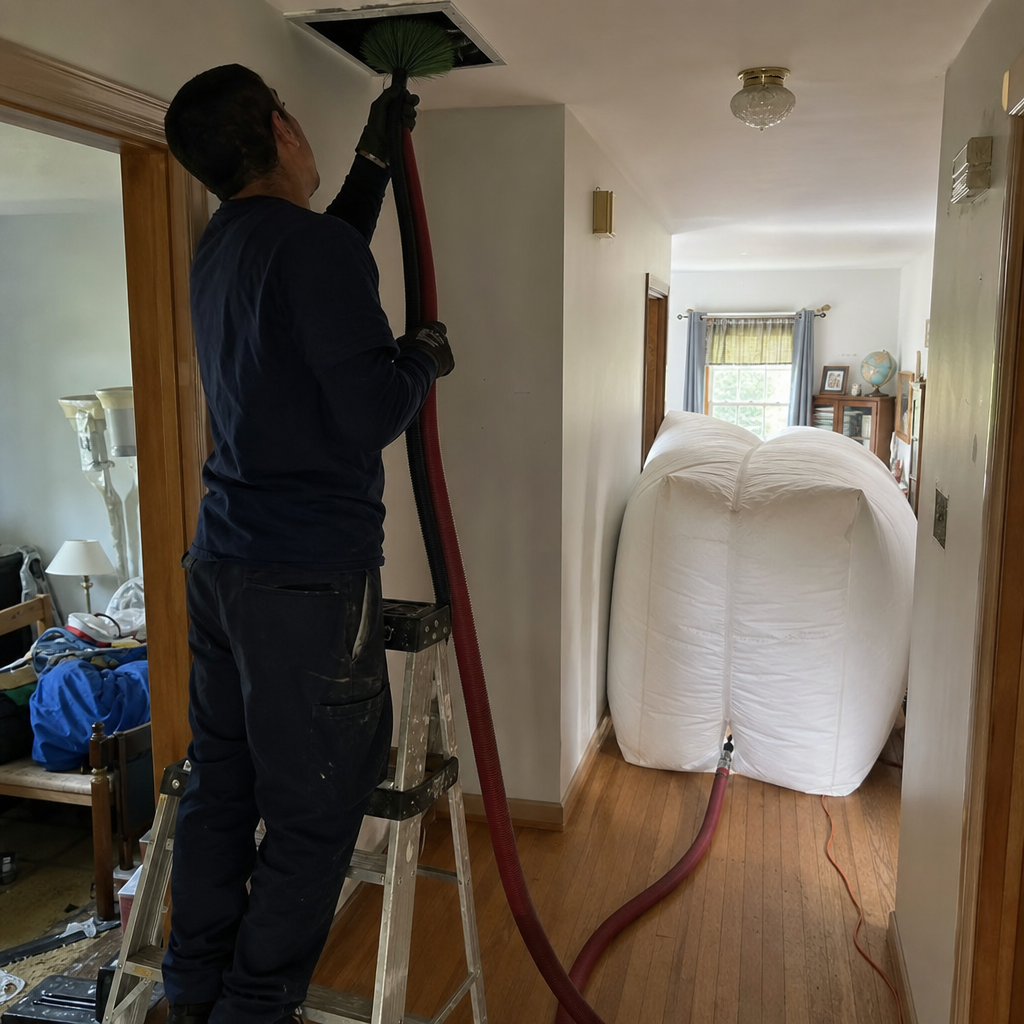
We seal all supply and return registers except the one being serviced, creating contained work zones. Our Nikro equipment generates true negative pressure — verified with manometer readings — so dislodged debris is captured at the source, not redistributed through your home. This is where consumer-grade equipment fails: without sufficient CFM and sealed containment, you’re just moving dust around.
Step 3: Mechanical Agitation with Commercial Brushes
Our Rotobrush system uses rotating bristle assemblies sized to duct diameter, physically dislodging adhered debris that suction alone won’t remove. For Bridgeport’s long horizontal trunk runs, we use extended-reach assemblies that navigate the full length without creating access holes. Two decades of duct systems means we’ve seen — and fixed — just about everything, including modified configurations that require custom brush sizing.
Step 4: HEPA Extraction and Filtration
All dislodged material passes through multi-stage HEPA filtration before exhaust. Our equipment captures particles to 0.3 microns — the scale of mold spores, pollen, and fine construction dust common in Bridgeport’s older housing.
Step 5: Sanitizing Treatment (Where Indicated)
For systems with documented mold or bacterial contamination, we apply EPA-registered treatments using Abatement Technologies and Guardsman products. This isn’t a default upsell — we recommend it only where camera inspection confirms active biological growth, typically in the humid basement sections we discussed earlier.
Step 6: Post-Cleaning Verification and Documentation
We re-run camera inspection through the same access points, providing before-and-after documentation. From cleaning to sealing to sanitizing — one call covers your entire duct system. If we find damage or disconnection during cleaning, we note it for repair discussion rather than ignoring it.
Franchise Crew vs. Owner-Operator: What the Documentation Actually Shows You
The national franchise model for air duct cleaning operates on volume: rapid dispatch, standardized protocols, and technician turnover that means the person in your home may have six months of experience. We’ve been called to re-clean after these crews in Bridgeport homes more times than we can count.
Here’s what the documentation typically reveals:
- Franchise “before” photos: Often generic stock images or blurry shots that don’t identify your specific registers
- Our before/after documentation: Timestamped, location-identified, with register labels visible — Matthew’s own recordings from your actual system
- Franchise equipment: Portable units that generate insufficient negative pressure for Bridgeport’s long trunk runs
- Our equipment: Truck-mounted Nikro systems and Rotobrush assemblies sized for commercial-grade performance — the same tools specified for medical and industrial settings
- Franchise scope: Often limited to “vent cleaning” — registers and visible boot only
- Our scope: Full mechanical system including trunk lines, plenums, and accessible returns, with repair and sealing available from the same technician
The critical difference is accountability. When Matthew Gonzalez is the owner and the lead technician, the reputation risk of substandard work is personal. 663 customers don’t leave 4.9 stars for average work. A franchise technician has no comparable stake — they’re following a playbook, not building a local reputation over two decades.
We use Rotobrush and Nikro equipment because your air quality isn’t a DIY project. These aren’t consumer brands you can buy at hardware stores; they’re professional systems with the agitation force and containment engineering that Bridgeport’s challenging duct configurations demand.
Triple-Deckers and Multi-Family Conversions: Cross-Contamination Risks
Bridgeport’s iconic triple-decker housing — three stacked residential units with common structural elements — creates duct contamination scenarios virtually absent from single-family suburban markets. We’ve cleaned systems in these properties across the East Side, West Side, and Hollow neighborhoods, and the patterns are consistent enough to warrant specific attention.
Shared duct chases without proper fire-stopping and sealing allow airflow between units even when systems are nominally separate. In one West Side triple-decker, we documented tobacco smoke particulate in a non-smoking third-floor unit that was entering through a deteriorated chase partition shared with the second-floor system. The occupants had spent years assuming their “allergies” were environmental; the actual source was a gap in construction separation that no previous service had identified.
Common basement furnace rooms serving multiple units create return air mixing. When one unit’s system is contaminated — whether from pets, smoking, or renovation debris — the shared basement space becomes a distribution point. Cleaning one unit without addressing the common elements is incomplete.
Post-industrial conversions with custom HVAC installations often lack the design documentation that would reveal these interconnections. We’ve found flex duct routed through former elevator shafts, shared exhaust pathways, and other improvisations that create unexpected airflow between units. Camera inspection is essential in these properties — assumptions based on visual inspection of registers are unreliable.
For property managers and owners of multi-family buildings in Bridgeport, we recommend system-wide assessment rather than unit-by-unit cleaning. The cost efficiency is better, and the contamination control is genuinely effective rather than cosmetically improved.
Air Duct Cleaning Costs in Bridgeport
Pricing for duct cleaning varies with system size, accessibility, and contamination level. In Bridgeport’s market, we’ve observed that legitimate owner-operators cluster in a narrower range than national franchises, which often advertise low entry prices then escalate with “required” add-ons.
| Service Level | Typical Bridgeport Range | What’s Included |
|---|---|---|
| Basic residential cleaning (1,000–1,500 sq ft) | $400–$550 | Supply and return registers, main trunk, visible boots; HEPA extraction |
| Full system cleaning (1,500–2,500 sq ft) | $550–$750 | All branches, plenums, accessible returns; camera documentation |
| Large or complex system (2,500+ sq ft, multiple zones) | $750–$900 | Extended reach assemblies, zone-by-zone isolation, detailed reporting |
| Mold remediation/sanitizing treatment | $150–$300 additional | EPA-registered application with Abatement Technologies or Guardsman products; post-treatment verification |
| Duct repair and sealing | $200–$600 | Boot reconnection, seam sealing, access panel installation |
Bridgeport-specific factors that affect pricing: basement accessibility (many older homes have tight utility spaces), plaster-and-lath construction that requires careful register removal, and the additional agitation time needed for long horizontal trunk lines. We provide exact quotes after inspection — never over-the-phone estimates that change on arrival.
Call (866) 531-5603 for a free, on-site estimate with no obligation. Estimates are free, and Matthew handles every assessment personally.
How Often Should Bridgeport Homes Clean Their Ducts?
The NADCA (National Air Duct Cleaners Association) general recommendation is every 3–5 years, but Bridgeport’s specific conditions suggest a more nuanced schedule.
Clean every 2–3 years if:
- Your home was built before 1980 and has original or minimally modified ductwork
- You live within a half-mile of Long Island Sound (elevated humidity baseline)
- You’ve completed any renovation without professional duct protection
- You have respiratory-sensitive occupants (asthma, allergies, COPD)
- Your home includes a finished basement with ductwork in conditioned space
Clean every 3–4 years if:
- Your home has updated ductwork (post-1990) with proper filtration
- You maintain consistent humidity control (whole-house dehumidifier or tight envelope)
- No recent renovations and no significant pet or smoking exposure
Clean immediately if:
- You observe visible mold growth inside registers or duct openings
- You’ve had water intrusion or flooding that contacted ductwork
- Pest infestation has been documented in or near duct runs
- Post-renovation occupancy with visible dust generation during construction
In Bridgeport’s rental market, we recommend landlords clean between tenancies as standard practice — the contamination profile of one occupant doesn’t predict the next, and documented cleaning protects both parties.
Common Mistakes to Avoid
- Hiring based on coupon price alone: The $99 duct cleaning advertised in Bridgeport typically covers register vacuuming only, with aggressive upselling for actual trunk cleaning. Legitimate equipment and labor can’t be deployed at this price point.
- Ignoring humidity control: Cleaning mold without addressing the moisture source that created it — common in Bridgeport’s Sound-proximate homes — guarantees recurrence within 12–18 months.
- DIY register cleaning as substitute: Homeowners who remove and wash registers address maybe 5% of system debris. The remaining 95% is in trunk lines and branches that require professional access and agitation.
- Failing to verify negative pressure: Any contractor who can’t or won’t demonstrate sealed containment with pressure verification is redistributing debris through your home during “cleaning.”
- Neglecting post-cleaning inspection: Without camera documentation of results, you have no verification that work was completed as specified. We provide this as standard; many competitors don’t.
- Assuming new homes are clean: Bridgeport’s post-industrial conversions and recent renovations often have the worst debris loading from construction activity that preceded occupancy.
When to Call a Professional
Call for assessment when you observe persistent dust accumulation shortly after cleaning, musty odors that intensify when HVAC cycles, visible debris in registers, or unexplained respiratory symptoms that worsen at home. In Bridgeport’s older housing stock, we also recommend professional evaluation before any major renovation — protecting ductwork during construction prevents the debris loading we so commonly find years later.
Elite Air Duct Cleaning Service Connecticut offers free estimates in Bridgeport — call (866) 531-5603. Matthew handles your job personally, and we’ll show you exactly what your system contains before any work begins.
Frequently Asked Questions
Most Bridgeport homes fall between $400 and $750 for complete system cleaning, with larger or multi-zone properties reaching $900. The city’s older housing stock — longer trunk runs, plaster construction, basement accessibility challenges — can add 10–15% compared to newer suburban markets. Call (866) 531-5603 for an exact quote — estimates are free.
Cleaning costs 15–25% of replacement for most Bridgeport systems, making it the economical choice unless ducts are structurally damaged, severely rusted, or improperly sized for the HVAC load. We evaluate this during inspection and recommend replacement only when cleaning won’t achieve functional improvement. Call (866) 531-5603 for assessment.
We typically schedule within 2–3 business days for standard cleaning, with same-day service available for urgent situations like post-flood contamination or real estate transaction deadlines. Emergency sanitizing treatments for documented mold can often be accommodated within 24 hours. Call (866) 531-5603 for current availability.
A thorough cleaning of a typical Bridgeport single-family home takes 3–5 hours. Triple-deckers and multi-zone systems may require 6–8 hours. The time investment reflects proper containment, mechanical agitation, and verification — rushed jobs skip steps that determine actual results.
It reduces allergen loading in the HVAC distribution system — pet dander, pollen, dust mite debris, mold spores — which can improve symptoms for sensitive individuals. In Bridgeport’s humid climate, we pair cleaning with humidity control recommendations for sustained benefit. It’s not a cure-all, but it’s a meaningful component of indoor air quality management.
Vent cleaning addresses visible registers and immediate boots only. Full duct cleaning — what we provide — includes all supply and return branches, main trunks, and plenums with mechanical agitation and HEPA extraction. In Bridgeport’s market, “vent cleaning” specials are commonly used as loss-leaders with mandatory upsells for actual system cleaning.
The Bottom Line
Bridgeport’s distinctive housing stock — pre-1980 colonials, triple-deckers, and post-industrial conversions — demands duct cleaning expertise that accounts for plaster dust, lead-paint particles, humidity-driven mold, and multi-unit cross-contamination risks. Generic national guides and franchise protocols miss these patterns because they’re designed for standardized suburban construction. A legitimate cleaning requires commercial-grade equipment, owner-level accountability, and process documentation that proves results. We’ve built our practice on exactly this combination over 20 years in Connecticut’s most architecturally diverse market.
Ready to see what’s actually in your Bridgeport ductwork? Call Elite Air Duct Cleaning Service Connecticut at (866) 531-5603 for a free, no-obligation estimate. Matthew handles every assessment personally — owner on-site, every time — and we’ll show you camera documentation of your system before any work begins. From cleaning to sealing to sanitizing, one call covers your entire duct system.
Written by Matthew Gonzalez, Owner & Lead Technician at Elite Air Duct Cleaning Service Connecticut, serving Bridgeport since 2006.