
Fast, Reliable Duct Repair & Sealing Across Farmingville
Duct repair and sealing in Farmingville typically costs $280–$650 for most residential jobs, with same-day service available throughout the 11738 ZIP code. If your utility bills are climbing, rooms stay stubbornly hot or cold, or you’ve spotted mold around your vents, your ductwork is likely leaking conditioned air into your walls and attic.
We’re Elite Air Duct Cleaning Service Connecticut, and we make the trip across the Sound to Farmingville regularly — usually arriving within 90 minutes of your call. Matthew Gonzalez, our owner and lead technician, has been crawling through Long Island attics and knee-wall cavities for 20 years. He knows the post-war ranches along Horseblock Road, the Cape Cods tucked behind Sipp Avenue, and the split-levels near the Farmingville Hills County Park. These aren’t generic houses to us. They’re the specific 1950s–1970s construction that dominates this hamlet, with the original galvanized ductwork, oil-to-gas conversion patches, and unventilated knee-wall cavities that create repair patterns you won’t find in inland markets. Call (866) 531-5603 for a free estimate — Matthew handles your job personally, owner on-site, every time.
Our Duct Repair & Sealing team doesn’t just patch leaks. We diagnose why your Farmingville ducts failed in the first place — because in this marine climate, they’ll fail again if you don’t address the root cause.
Why Elite Air Duct Cleaning Service Connecticut Is Farmingville’s Preferred Duct Repair & Sealing Company
We’ve earned 663 verified reviews averaging 4.9 stars across our service territory, and Farmingville customers specifically mention the difference of having the same experienced technician return for follow-up work. No rotating crews. No re-explaining your house’s quirks to someone new.
Matthew Gonzalez personally leads every job as the head technician. That means the person quoting your repair is the one sealing your ducts, inspecting your knee-wall cavities, and standing behind the warranty. Two decades of duct systems means we’ve seen — and fixed — just about everything.
Our response time to Farmingville averages under 90 minutes during business hours. We carry Rotobrush and Nikro equipment in every van, plus mastic sealant, fiberglass liner, and insulated flex duct in common diameters. Most repairs finish in a single visit.
We also understand the local permit landscape. Suffolk County’s residential HVAC modifications don’t always require permits for simple duct sealing, but when we’re replacing metal trunk lines or modifying distribution after an oil-to-gas conversion, we know when to pull the proper documentation. Farmingville homeowners don’t need surprises from the building inspector.
Our Duct Repair & Sealing Services in Farmingville
Duct Sealing
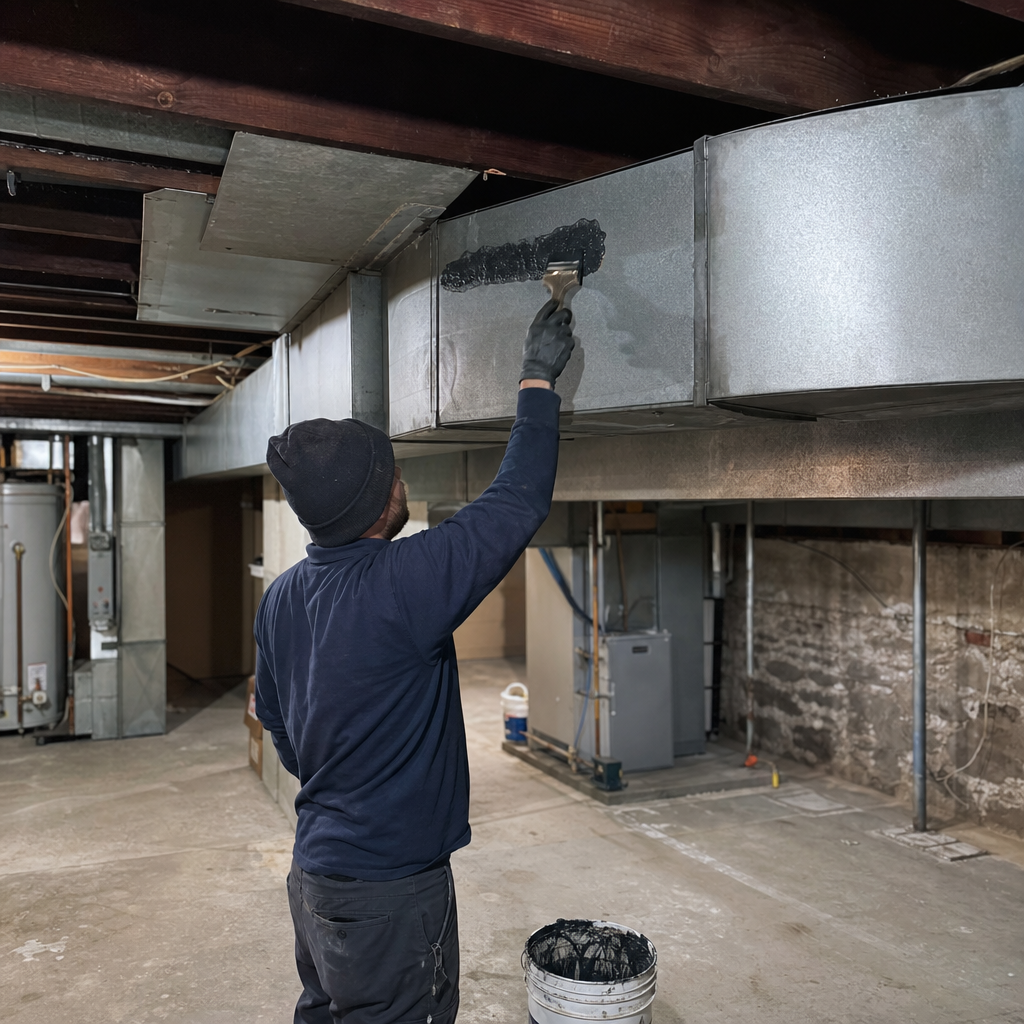
Leaky ducts waste 20–30% of your conditioned air before it reaches your rooms. In Farmingville, the problem compounds because your HVAC runs harder to overcome humidity loads, so every cubic foot of cooled air that escapes into your attic costs more than it would in drier climates. We pressurize your system and use smoke pencils to locate every leak — at plenum connections, register boots, and the old transition points where galvanized meets flex. Then we seal with mastic sealant, not tape. Mastic remains flexible through Long Island’s freeze-thaw cycles and won’t degrade in the damp attic conditions that are normal here from April through October.
Flex Duct Repair
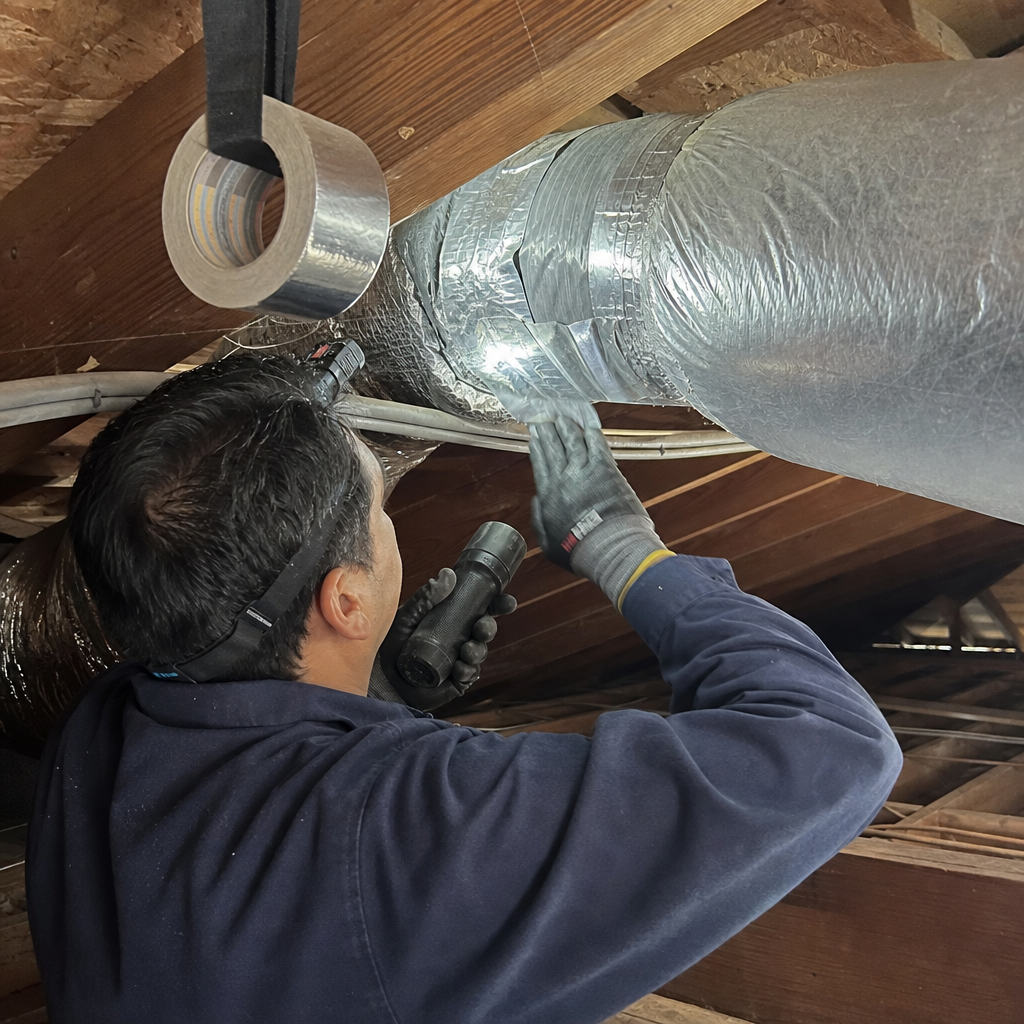
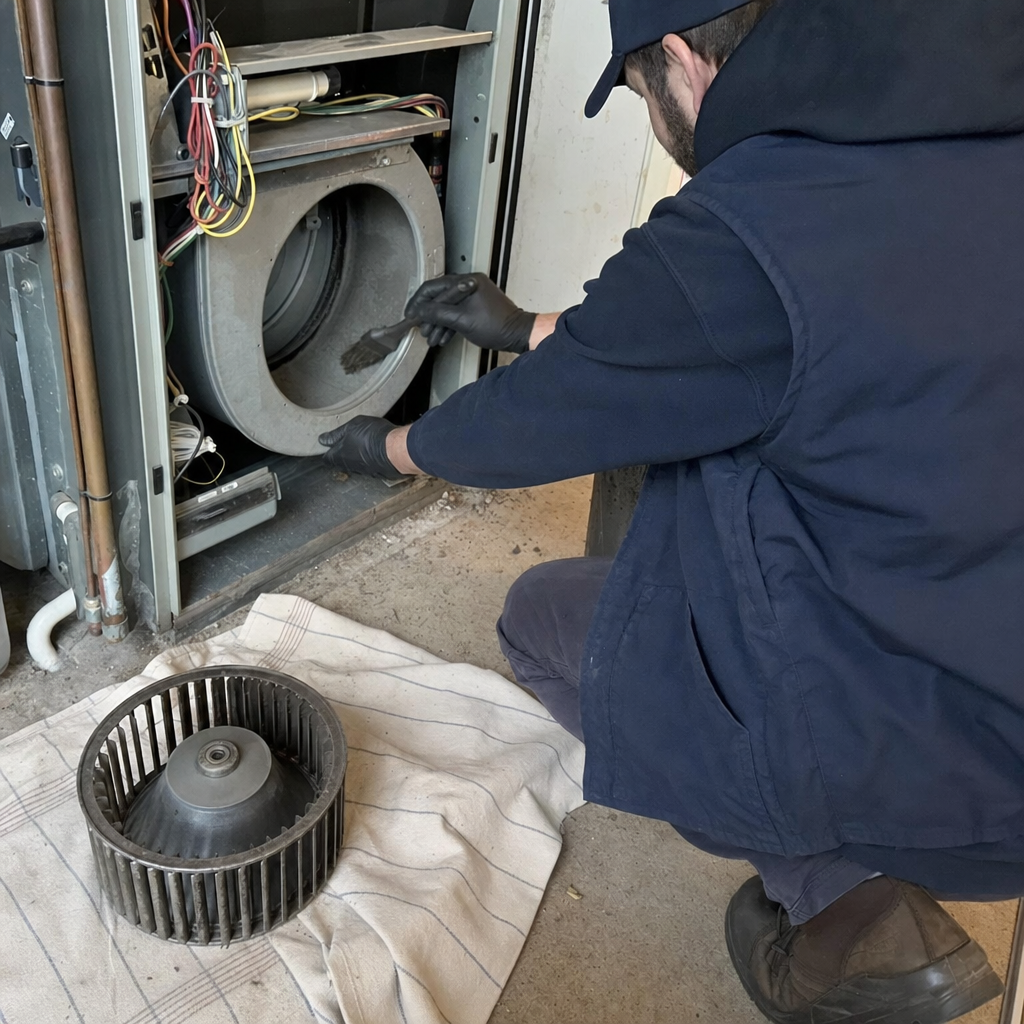
Farmingville’s 1970s split-levels and converted attics are full of flex duct that has reached end-of-life. The plasticized outer layer cracks. The fiberglass insulation compresses. The inner liner tears at bends. We replace damaged runs with new insulated flex, properly supported every four feet and sealed with draw bands plus mastic — never duct tape, which fails in humid attics within two years. We recently repaired a flex-duct run in a Cape Cod’s knee-wall on West Avenue in Farmingville. The homeowner had no idea the duct was there until we pulled a grille — the fiberglass liner had delaminated from moisture trapped all summer, and we sealed the leak and insulated the cavity with mastic sealant.
Metal Duct Repair
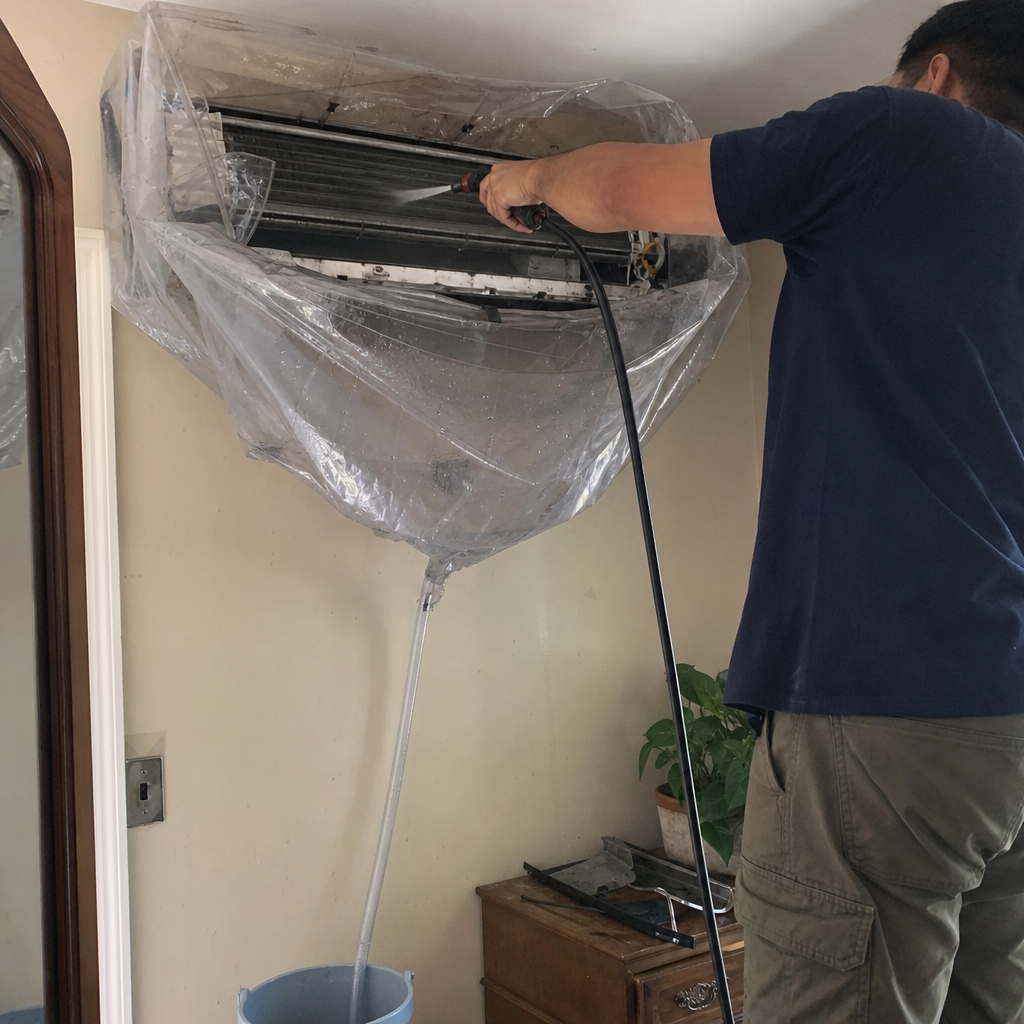
The original galvanized steel in Farmingville’s 1950s ranches is a mixed blessing. It lasts longer than flex, but when it fails, it fails with rust-through at seams and corrosion at fasteners. In knee-wall cavities, uninsulated metal ducts sweat so badly that corrosion forms at fastener seams within three years, necessitating full metal duct repair rather than simple sealing. We cut out damaged sections, fabricate replacement trunk line from 26-gauge galvanized, and seal with mastic and fiberglass mesh. Where metal meets new flex, we use proper start collars and mechanical fasteners — the kind of detail that prevents the debris gaps we see at old oil-to-gas conversion points.
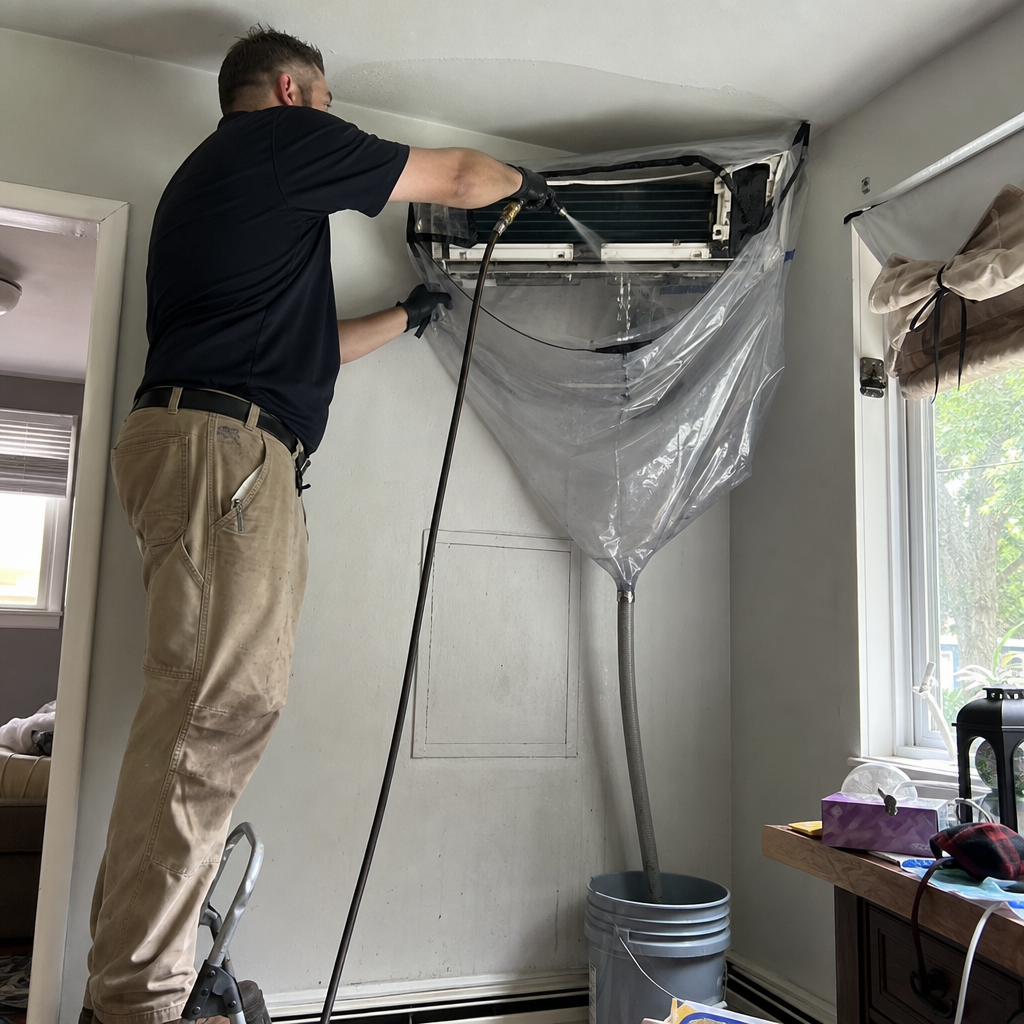
Duct Insulation
Attic-routed ducts in Farmingville need more than just sealing. Long Island’s maritime climate means summer dew points regularly exceed 65°F, and even winter air carries more moisture than inland New York regions. This sustained humidity causes condensation inside attic-routed ducts during both shoulder-season swings, accelerating fiberglass liner breakdown and creating the damp conditions that sustain mold between cleanings. We wrap repaired ducts with R-6 or R-8 insulation, sealed with vapor-barrier jacketing, to keep the metal surface temperature above the dew point. In knee-wall cavities, we sometimes recommend rigid foam board insulation around the duct chase itself — turning an unventilated moisture trap into a conditioned micro-environment.
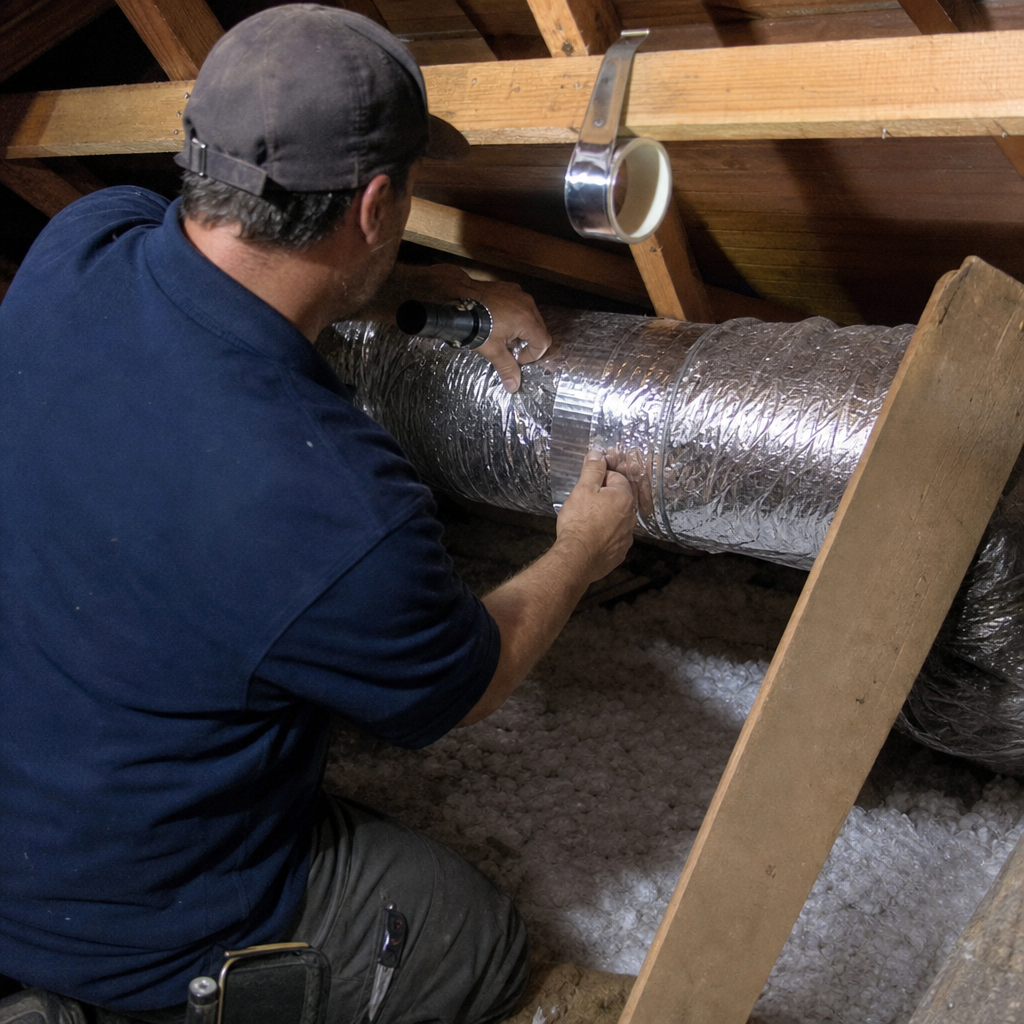
Mastic Sealant Application
Mastic is our primary sealant for every Farmingville job. It’s a thick, water-based compound that brushes onto joints and cures to a flexible, durable seal. Unlike foil tape or butyl tape, mastic won’t delaminate when attic humidity spikes to 85% in August. We apply it with a minimum 2-inch overlap at all connections, then embed fiberglass mesh at high-stress joints. For oil-to-gas conversion patches where dissimilar metals meet, we use high-temperature mastic rated for the temperature swings of modern gas furnaces.
What happens when you call
- 1
A real person answersNo phone trees — you reach a local pro.
- 2
You get an upfront price rangeHonest numbers before anyone is dispatched.
- 3
A background-checked tech heads outLicensed & insured, dispatched right away.
- 4
You approve before work beginsNothing starts until you say go.
Trusted Brands We Service in Farmingville
We don’t show up with hardware-store supplies. Our vans carry professional-grade equipment from Rotobrush and Nikro — the same commercial-tier tools used in industrial and medical settings, not consumer vacuums. For air quality and sanitizing treatments after repair work, we use Abatement Technologies HEPA filtration and Guardsman antimicrobial products. We stock common duct diameters, start collars, and register boots so Farmingville customers aren’t waiting for parts. Most repairs finish same-day.
Common Duct Repair & Sealing Problems We See in Farmingville Homes
- Knee-wall mold in Cape Cods. Many Farmingville Cape Cods hide ductwork inside unventilated knee-wall cavities on the upper half-story, trapping summer humidity so persistently that these runs almost always show the heaviest mold growth in the house — a hidden problem unique to this hamlet’s 1950s housing stock. Homeowners smell mustiness upstairs every July and can’t find the source until we pull the grille.
- Fiberglass liner breakdown in attic flex ducts. Condensation inside attic-routed ducts during shoulder-season humidity swings accelerates fiberglass liner breakdown, creating leak points that require frequent sealing. We see this most in the original 1970s flex that was never designed for Farmingville’s year-round marine moisture.
- Debris gaps at oil-to-gas conversion points. Oil-to-gas HVAC conversions left legacy galvanized duct connections prone to debris gaps at old transition points, where mastic sealant fails faster than in new systems. The old oil furnace had a larger plenum connection; the patch job often leaves a step or gap that collects dust and leaks air for decades.
- Corroded fastener seams in uninsulated metal. In knee-wall cavities, uninsulated metal ducts sweat so badly that corrosion forms at fastener seams within three years, necessitating full metal duct repair rather than simple sealing. By the time homeowners notice reduced airflow, the trunk line has pinholes along its entire length.
Pricing for Duct Repair & Sealing in Farmingville, NY
Here’s what typical duct repair and sealing costs in the Farmingville market:
| Service | Typical Range |
|---|---|
| Basic duct sealing (single system, accessible attic) | $280–$420 |
| Flex duct repair/replacement (per run) | $180–$340 |
| Metal duct repair (section replacement with fabrication) | $350–$650 |
| Knee-wall cavity repair with insulation upgrade | $450–$780 |
| Full system mastic sealant application | $380–$580 |
| Air quality testing post-repair | $125–$195 |
What moves you up or down within these ranges: accessibility (crawl space vs. walk-up attic), extent of mold remediation needed before sealing, whether we need to cut drywall to reach knee-wall ducts, and if your system requires balancing after repair. We quote upfront — no open-ended hourly billing. Every estimate is free, and Matthew Gonzalez personally assesses your system before any work begins. Call (866) 531-5603 to schedule.
We Also Serve Cities Near Farmingville
Our service radius covers the full Suffolk County corridor. We regularly perform duct repair and sealing in Holtsville (just west along the LIE), Selden (north toward Port Jefferson), Centereach (east toward Middle Country Road), and Holbrook (south toward the Sunrise Highway). Same response standards, same owner-led crews, same equipment. If you’re in a neighboring community and found this page, we service your area too.
Serving Farmingville, NY — Our Local Coverage Area
We’re based in the Farmingville area and know this community well. Use the map below to see our service coverage — if you’re nearby, we can almost certainly help.
FAQs — Duct Repair & Sealing in Farmingville
Your knee-wall cavity traps humid air with no ventilation, and the temperature differential between the hot roof deck and your cooled duct surface creates condensation for hours every day. We solve this by sealing all duct leaks with mastic, adding proper insulation, and sometimes installing a small vent or dehumidification strategy for the cavity itself. Call (866) 531-5603 — Matthew can assess whether your specific knee-wall configuration needs just sealing or a more comprehensive moisture control approach.
Most original galvanized metal ducts in Farmingville’s 1950s ranches can be repaired if the corrosion is localized to seams and connections. We cut out damaged sections, fabricate replacement pieces, and seal with mastic. Full replacement becomes necessary when the trunk line has widespread pinholing or when the original design is so inefficient that repair won’t solve your comfort problems. Matthew evaluates this on every job — we’ll tell you honestly when repair is throwing good money after bad. Free estimates at (866) 531-5603.
Yes — basement ductwork leaks into wall cavities and unfinished spaces, pressurizing your basement and depressurizing your living areas. In Farmingville’s humid climate, that pressure differential pulls moist soil gas and musty basement air upstairs. Sealing basement ducts often improves comfort more than attic sealing because the leaks are closer to your living space. We test pressure balance before and after. Call for a free assessment.
Given Farmingville’s persistently elevated relative humidity from marine air exposure, we recommend inspection every 2–3 years for homes with attic or knee-wall ductwork. Basements can stretch to 4–5 years if no water intrusion exists. Homes with prior mold issues, or those that underwent oil-to-gas conversions with legacy patching, should schedule annual checks. We offer maintenance plans that include inspection plus priority scheduling. Call (866) 531-5603 to set up your first visit.
Sometimes — if the register boot is accessible and the duct run is straight, we can seal from the grille side using extended applicators and camera inspection. More often, the worst leaks are at hidden joints that require a small access panel, which we cut cleanly, seal, and patch to match your wall texture. We discuss both options before starting, and we never open walls without your approval. Matthew shows you the camera footage so you understand why access is or isn’t needed. Free estimate at (866) 531-5603.
Written by Matthew Gonzalez, Owner at Elite Air Duct Cleaning Service Connecticut, serving Farmingville and Long Island since 2004.